
What Happens When You Remove Colors
Stripping colour does not simplify. It reveals. When you shoot black and white, you see light for the first time.
The Acros simulation is loaded. The X-E5’s electronic viewfinder goes monochrome. The world through the eyepiece loses its warmth, its saturation, its easy emotional shortcuts — and something else appears.
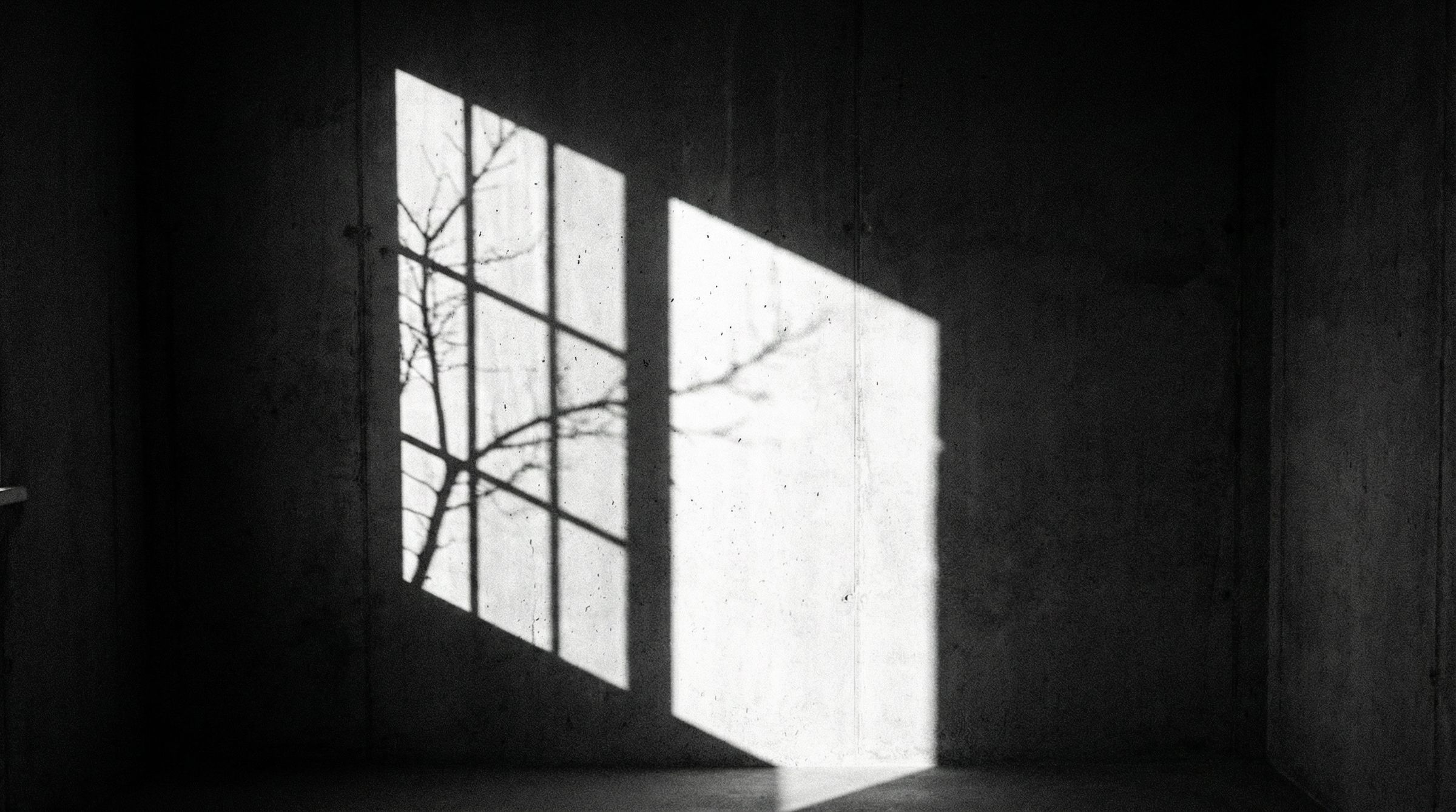
Shadows. Not as absence, but as architecture. The shadow under the cliff face at Ribeira d’Ilhas is not just dark. It has gradient, density, direction. It falls across the wet sand in a shape that tells you exactly where the sun is, how high, how filtered by cloud. In colour, I would have seen “a dark area near some rocks.” In black and white, I see the light source mapped onto the landscape by its own negative.
Texture becomes the story. The grain of wet stone. The roughness of dried salt on a wetsuit hung over a fence rail. The fine lines on a face caught in late afternoon side-light. Colour hides these details — not intentionally, but inevitably. The eye goes to the brightest hue first. Red before texture. Blue before form. The colour photograph shows you what things are. The monochrome photograph shows you what things look like.
I am walking the coast path south of Ericeira. The X-E5 weighs 364 grams. The XF 35mm f/1.4 adds another 187. Half a kilo of camera, one focal length, no colour. The constraint stack is three layers deep: one body, one lens, one simulation. Every photograph I take in the next hour will be composed entirely from light, shadow, line, and form. Nothing else is available.
This is the photographic equivalent of playing guitar without effects pedals. The instrument is naked. If the composition is weak, there is nowhere to hide. No saturated sunset to rescue a mediocre frame. No vivid blue ocean to make a boring scene feel alive. The image works on structure alone or it does not work at all.
Lindbergh understood this at a level most photographers never reach. His black and white portraits stripped the fashion industry’s entire visual language down to light on skin. No retouching. No colour grading. No atmospheric manipulation. Just a face, caught in available light, printed with the full tonal range from paper white to deep black. The industry called it radical. He called it honest.
Fujifilm’s Acros simulation is not Tri-X. It is not HP5. It is its own thing — fine grain, smooth tonal transitions, a controlled highlight rolloff that keeps detail in the whites without crushing them. When I push it one stop in camera — the way I would push Tri-X in the darkroom — the midtones gain weight and the shadows deepen into something that feels dimensional. The grain structure tightens. The image stops looking like a digital conversion and starts looking like a photograph that was always meant to be monochrome.
A fishing boat sits beached on the sand, listing slightly. In colour, it would be blue and white, chipped paint, tourist-brochure Portugal. In Acros, it is a study in hull geometry. The curve of the keel. The shadow it casts. The rope coiled next to it, catching light on every twist. I see the boat differently because I am seeing light differently. The colour was a label. The monochrome is an observation.
The sun drops behind the cliff. The light goes soft and directionless. I stop shooting. Not because the scene is less interesting — it is — but because monochrome without shadow is monochrome without structure. The tool tells you when to stop, if you listen.
Colour is generous. It forgives lazy composition. It fills the frame with information that the viewer processes as beauty even when the underlying structure is weak. Remove it, and you see what was always there: light doing its work, or not doing it. Shadow giving shape, or failing to.
Stripping colour is not simplification. It is a confrontation with what you actually see versus what you assumed you were seeing. Most photographers never make it through that confrontation. The ones who do never fully go back.
More from this domain
25 Aug 2026
PhotographyThe Case for Printing
The screen is a proof. The print is the photograph. An image that only ever lived on glass is unfinished work — a mix you never bounced.
24 Jul 2026
PhotographyHow to Read Light
Reading light is a trained skill, not luck. You see the finished frame before you raise the camera — the same way you read a set before it stands up.
16 Jun 2026
PhotographyThe GFX Question
The GFX 100S is not a better X-E5. It is a different instrument, and I keep the X-E5 anyway.