
The GFX Question
The GFX 100S is not a better X-E5. It is a different instrument, and I keep the X-E5 anyway.
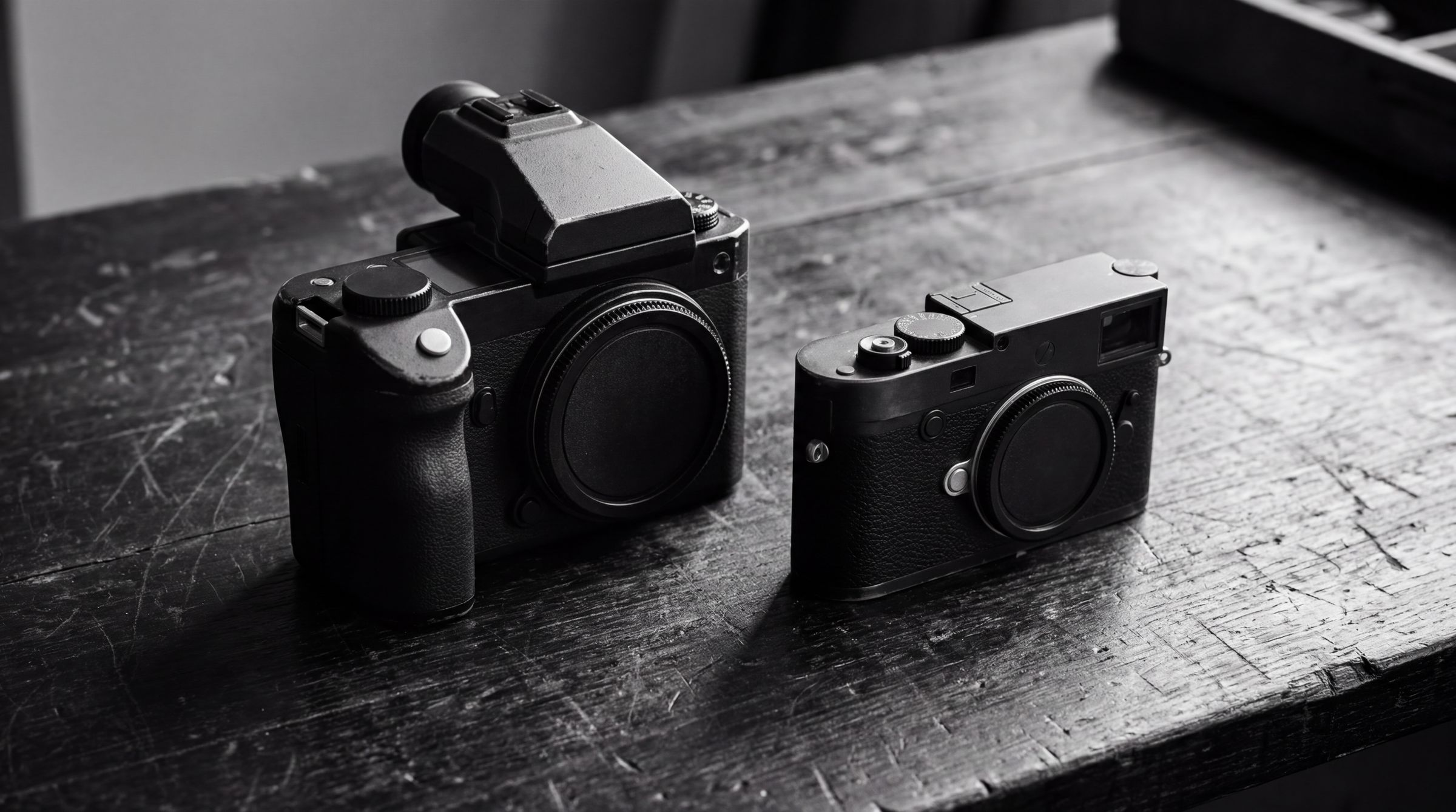
The Fujifilm GFX 100S weighs 900g with battery and card. The X-E5 weighs 445g. Almost exactly twice the mass, and the first thing everyone asks is whether the heavier body takes better pictures. Wrong question. That framing assumes the GFX sits at the top of a ladder the X-E5 is standing on. It doesn’t. The two cameras are not on the same ladder.
Here is the sensor that starts the argument. The GFX 100S carries a 43.8×32.9mm array — 1,441mm² of silicon — against the X-E5’s 23.5×15.7mm APS-C sensor at roughly 369mm². That works out to roughly 3.9× the sensor area. Not 3.9× the resolution, not 3.9× the sharpness. Area. A larger surface catching the same light, projected by a lens designed to cover it.
The number that misleads
The GFX resolves 102 megapixels — 11648×8736 pixels off an X-Processor 4 pipeline. Spread that across a 43.8mm width and each photosite works out to around 3.76μm pitch, which is not a Fujifilm-published spec but a division anyone can do from the two numbers on the page. That pixel pitch is the tell. The GFX isn’t cramming smaller wells to chase a headline count. It spends the extra area on bigger pixels and more of them. The X-E5’s 40.2MP on APS-C is a dense, excellent sensor. The GFX plays a different physical game entirely.
Resolution is the least interesting thing the format does. Independent testing — DPReview’s review of the 100S shadow files — found clean, artifact-free recovery when you lift the darkest tones, no striping across the phase-detection rows even after aggressive shadow pulls. That is more latitude than APS-C gives up before it breaks. Fujifilm publishes no stills dynamic-range-in-stops figure for the 100S, and the “14+ stops” number floating around belongs to a newer body’s video mode, not this camera. Ignore it. What matters is qualitative and I have seen it: highlight rolloff and shadow latitude that behave like a wider canvas, because that is what they are.
The lenses render backwards
This is where the instrument reveals itself. Mount the GF 63mm f/2.8 R WR — 405g — and Fujifilm’s own spec calls it a 50mm-equivalent field of view. A 63mm lens giving you a 50mm frame. On the X-E5, the math runs the opposite direction: a 35mm lens renders like a 53mm, the APS-C crop factor of roughly 1.5× making every focal length render tighter than its number. The GFX crop factor is 0.79× relative to full-frame. GF glass renders wider than its number.
Sit with that. To fill the frame the way a 50mm does, the GFX uses an actual 63mm of focal length. To reach an 87mm portrait framing, the GF 110mm f/2 R LM WR — 1,010g of it — puts a genuine 110mm in front of the sensor. Longer real focal length at the same field of view means shallower depth of field and more subject-to-background separation at a given aperture and distance. The “medium format look” people chase in blurry gear-forum threads is not mysticism. It is a 110mm lens doing 110mm things while framing like an 87mm.
What each one is for
The X-E5 is 445g of camera I put in a jacket pocket and carry every day. Aperture ring, shutter dial, film simulation dial — decisions set by thumb before the frame. It is the single-fin. It goes everywhere and asks nothing.
The GFX 100S plus the GF 110mm f/2 is nearly 2kg on a strap before you add anything else. It does not go in a pocket. It goes on a tripod, or on a shoot where the subject holds still and the light is controlled, and it renders skin and tonal transition in a way the smaller sensor physically cannot match at the same framing. That is not the X-E5 failing. That is the GFX doing a job the X-E5 was never built to do.
Choosing between them is not an upgrade decision. It is instrument selection — the same call as reaching for a 6’2” single-fin instead of a shortboard because the wave is asking a different question, or plugging a Les Paul into a clean channel instead of an overdriven JCM800 because the song needs sustain, not bite. Neither is the better tool. Each is the right tool for exactly one kind of work.
I own both. I reach for the X-E5 ninety percent of the time. The GFX 100S is not what I use when I want a better photograph. It is what I use when I want a different photograph — one the format makes possible and the pocket camera never could.
Buy the GFX because you need what medium format renders. Never buy it because you think it is a nicer X-E5. It isn’t. It is a different instrument.
More from this domain

25 Aug 2026
PhotographyThe Case for Printing
The screen is a proof. The print is the photograph. An image that only ever lived on glass is unfinished work — a mix you never bounced.
24 Jul 2026
PhotographyHow to Read Light
Reading light is a trained skill, not luck. You see the finished frame before you raise the camera — the same way you read a set before it stands up.
22 May 2026
PhotographyOcean Photography Is Not Surf Photography
The ocean is a subject that demands the same reading as the wave you paddle for. Shutter speed decides what the water is allowed to be.