
PAF: The Pickup That Should Not Exist
Gibson printed the wrong patent number on its own legendary pickup for years. The PAF fails every modern QC test — and that failure is the tone.
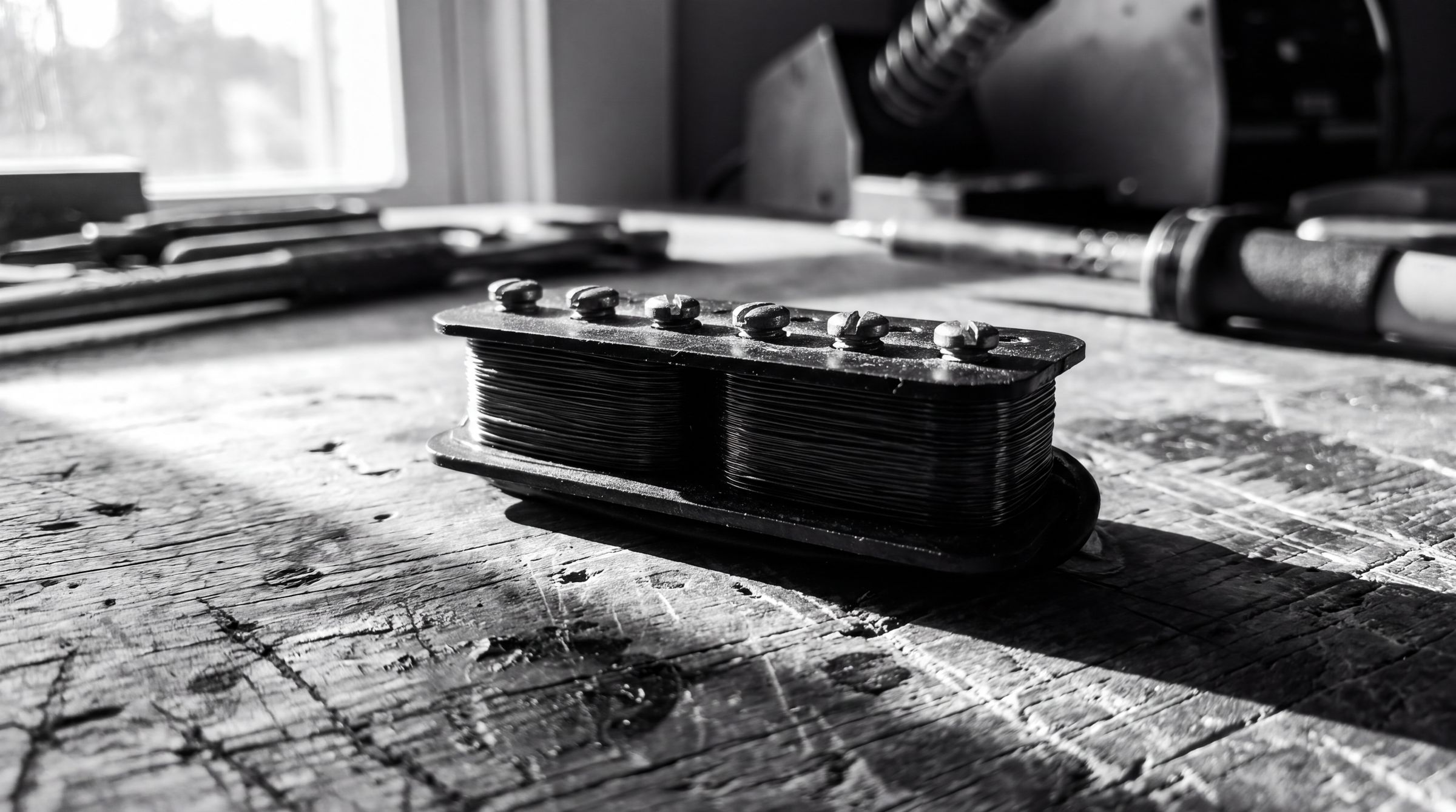
Gibson printed the wrong patent number on its most important pickup, and kept printing it for years. The sticker on the underside read “Patent No. 2,737,842.” That patent covers a trapeze tailpiece from 1952. The actual humbucker — the one every player means when they say PAF — is US Patent 2,896,491, Seth Lover for Gibson, filed June 22, 1955, granted July 28, 1959. The company advertised the wrong invention on the part that made it famous. The error reportedly persists on Gibson’s own site today.
That is not a footnote. That is the personality of the whole object.
“PAF” is not a model. It is a decal — “PATENT APPLIED FOR” — stamped on production pickups from 1957, before the patent-number sticker replaced it sometime in the early 1960s. Nobody engineered a “PAF.” They wound a coil, dropped a magnet in, screwed on a cover, and shipped whatever came out.
The Machine Had No Counter
Start with the winding, because the winding is the myth and the myth is wrong. PAF coils were not hand-wound. Seth Lover said it himself in 1978: the machine had an automatic traverse, laying 42 AWG plain-enamel copper wire across the butyrate bobbin under mechanical guidance. That part was mechanized.
What the machine did not have was an automatic turn-counter or an automatic stop. A person watched it and killed it by eye. When the wire snapped mid-run — and fine 42-gauge wire snaps — the operator often could not stop the spindle in time. Lover’s own words: “you could have a coil that might have 50 or 100 less turns, depends how quickly you stop the machine.”
So the nominal target was somewhere around 5,000 turns a coil. Maybe. Interviewed decades later, Lover contradicted himself inside a single answer — “about 6,400 turns,” then “in between the 4 and 5k range.” The inventor could not tell you the spec. There was no spec. There was a machine, a human, and a reaction time.
That variance shows up on a multimeter. Documented DC resistance across original PAFs runs roughly 7k to 9k ohms — individual units measured down into the upper-6k range and as high as around 9.5k. DC resistance, not impedance; the multimeter reads a static coil, not a frequency-dependent load. That spread of two-plus thousand ohms is the difference between a pickup that stays clean and one that pushes a Marshall front end into break-up on its own. Two pickups off the same bench, meant to be identical, voiced differently. Nobody chose that. The stop button chose it.
The Magnet Lottery
Then the magnet, and it gets worse. PAFs used Alnico 2, 3, 4, and 5 — all four grades, chosen not for tone but for whichever supplier had stock at the right price on the day. Lover was blunt about it: they bought from “whoever could supply and make deliveries at the time that they needed them and had the best price.”
Four different magnetic alloys means four different flux strengths, four different attack-and-sag characters, distributed at random through production. And Gibson magnetized the bars in batches, so charge strength varied unit to unit even within a single grade. A hotter-charged Alnico 2 and a weaker Alnico 5 could land in guitars shipped the same week. The coils are unpotted — no wax seal — so the whole assembly stays slightly microphonic, alive to the body’s resonance in a way a potted modern pickup kills on purpose.
Machine-wound with no counter. Magnet grade by invoice. Charge by batch. No wax. A nickel-silver cover over the top and out the door.
The Take
By every standard a modern factory would recognize, the PAF is a manufacturing failure. No repeatable turn count. No controlled DC resistance. No specified magnet. No potting. If a QC engineer measured a production run this loose today, the line would stop.
That looseness is exactly what boutique builders now spend years and real money trying to put back. ThroBak molds butyrate bobbins and sources the same four Alnico grades not to hit a number but to hit a distribution — to rebuild the scatter, not the spec. They are manufacturing inconsistency on purpose, because consistency was never the sound.
Here is the reference point. A modern ceramic humbucker gives you 16k of hot, tight, identical output, unit after unit, forever. It is a better tool. It is more reliable, more predictable, easier to build. And it sounds like every other one.
The PAF sounds like the day it was made. The tone people chase for seventy years is a record of a wire that broke, a magnet that happened to be in the bin, and a person who was a half-second late on the switch. Perfection is a number you can hit twice. Character is the number you got once and never got again.
More from this domain
3 Aug 2026
MusicThe Accidental Circuit
The Neve 1073 is the most worshipped preamp in recording, and the sound everyone chases is a defect its own designer set out to engineer away.
1 Jul 2026
MusicThe Floor Under House Music
The TR-909 and TB-303 were flops. That is the reason house exists — I can trace the whole genre to a supply chain of failed gear.
3 Jun 2026
MusicBuilding the Beast by Hand
I assembled an 80s superstrat part by part, period-correct, across three continents. Not because old is better. Because every spec is load-bearing.