
The Accidental Circuit
The Neve 1073 is the most worshipped preamp in recording, and the sound everyone chases is a defect its own designer set out to engineer away.
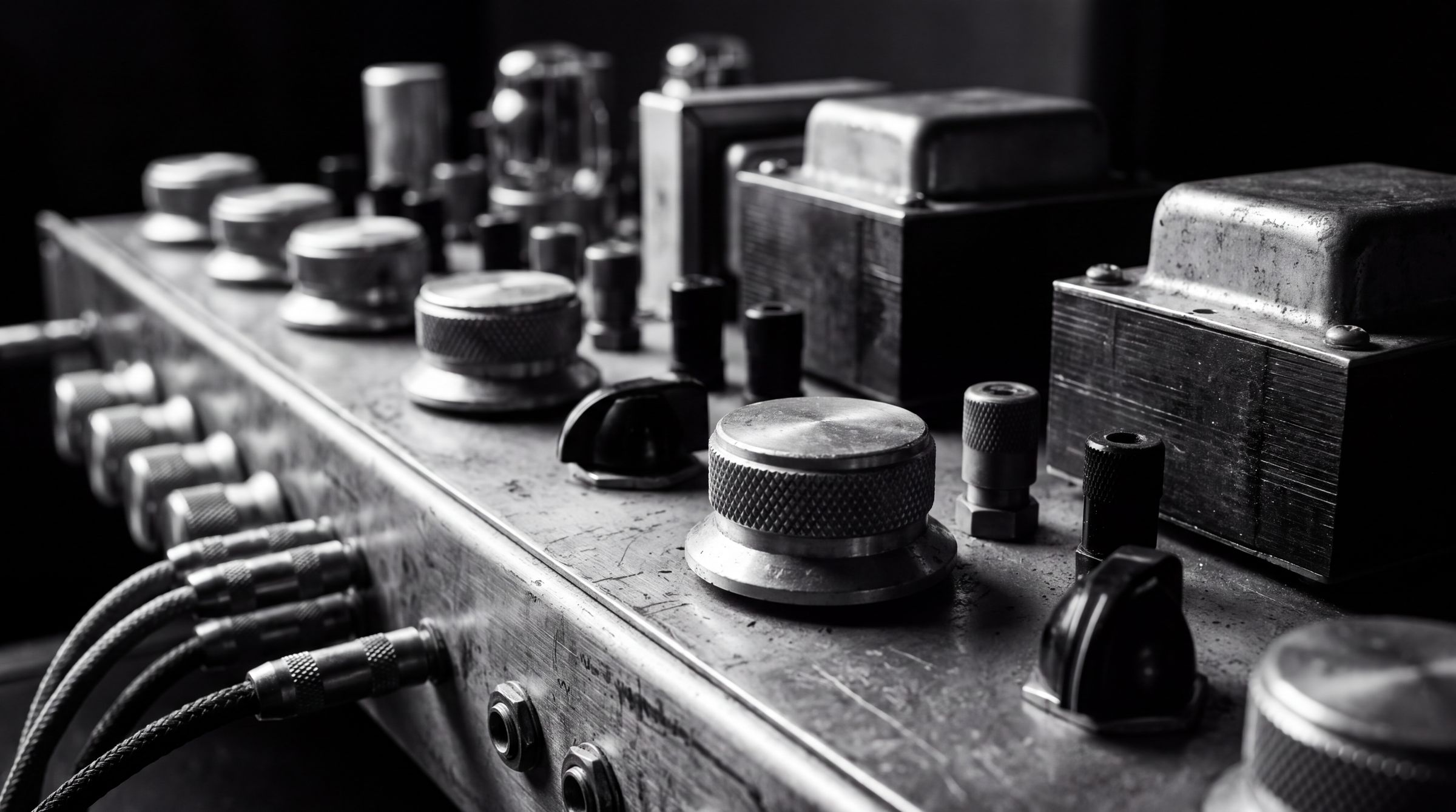
The Neve 1073 is the most worshipped mic preamp in the history of recording, and the sound everyone worships is a byproduct its own designer never asked for.
Rupert Neve wanted transparency. Not warmth. Not “colour.” Not the thick, forward midrange that clone-makers now chase across three continents at boutique prices. Transparency — the signal in, the same signal out, only louder and cleaner. A wire with gain. That was the brief Neve set, stated plainly in interviews: the main interest was the high-quality recording of real sound, and a tenth of a decibel of deviation across 20Hz to 20kHz was enough to bother that ear. The harmonic saturation that made the 1073 a legend was never on the spec sheet. It was never intended. The company that owns the trademark and the schematics says so, in writing, on its own history page: the transformers were installed “primarily for signal isolation & gain staging,” and the pleasant harmonic colour was “an unexpected benefit” that “was never intended.”
Read that again. The sound was an accident. The manufacturer admits it.
Here is the circuit that produced it. 1970. Wessex Studios in London commissioned Neve and the engineering team to build a console for music recording — the A88 — and the 1073 was the module fitted to it. Discrete Class-A throughout: no op-amp chips, every gain stage built from individual transistors, silicon BC182/BC184 devices arrived at after years of moving off germanium. Mic gain from +20dB to +80dB in 5dB steps, input impedance switchable 300Ω or 1200Ω. A three-band EQ that is still a masterclass in restraint: a fixed 12kHz HF shelf, a midrange peak selectable at 0.36, 0.7, 1.6, 3.2, 4.8 or 7.2kHz, an LF shelf at 35, 60, 110 or 220Hz, and a separate 18dB-per-octave high-pass filter at 50, 80, 160 or 300Hz. By the manufacturer’s own current figures the circuit runs cleaner than the myth suggests — distortion no worse than 0.07% from 50Hz to 10kHz, frequency response flat to ±0.5dB across the audio band. Those are transparency numbers. Neve built exactly what the brief set out to build.
So where does “the sound” come from. The transformers. Three of them, Marinair-specification — mic input part 10468, line input 31267, output LO1166, that last one gapped. Neve put them there for a boring, correct engineering reason: total galvanic isolation. Earth-free, balanced, immune to ground loops and RF, one studio’s power supply kept from talking to another’s. Isolation is what a transformer does. But drive current through iron and the core does not respond in a perfectly straight line — at level, it adds low-order harmonics the input never contained. That is the “sound.” A rounding, a density, a thickening that sits under the signal.
Now the honest part, because this is where the folklore takes over from the record. Neve and the engineering team never fully documented which part of the circuit was responsible. Engineers who have studied it since generally point to the output transformer saturating under level — but Neve’s own account only says the effect was “never intended.” I will not hand you a saturation percentage. Nobody measured one in 1970, and the round numbers you see quoted on forums are invented. The mechanism is real. The precise figure is fiction.
This is the part worth keeping, and it is not nostalgia — it is engineering honesty. The 1073 did not become a classic because a genius set out to design a beloved tone. It became a classic because a genius set out to design a transparent tool and the physics of the components chosen for isolation left a fingerprint the design tried to keep out. Character was the residue, not the goal. The pursuit of clean is what produced the thing everyone now calls dirty.
That inversion runs through every craft I work in. The best surfboard rocker is a compromise between speeds you cannot both optimise. The most useful lens rendering comes from aberrations the designer corrected as far as budget allowed and no further. The tone you fall in love with is almost never the tone someone engineered on purpose — it is what leaked through while they were chasing something cleaner.
Rupert Neve chased a wire with gain. Neve missed, by a few harmonics, in the direction of immortality.
More from this domain
4 Sept 2026
MusicPAF: The Pickup That Should Not Exist
Gibson printed the wrong patent number on its own legendary pickup for years. The PAF fails every modern QC test — and that failure is the tone.
1 Jul 2026
MusicThe Floor Under House Music
The TR-909 and TB-303 were flops. That is the reason house exists — I can trace the whole genre to a supply chain of failed gear.

3 Jun 2026
MusicBuilding the Beast by Hand
I assembled an 80s superstrat part by part, period-correct, across three continents. Not because old is better. Because every spec is load-bearing.