
The Floor Under House Music
The TR-909 and TB-303 were flops. That is the reason house exists — I can trace the whole genre to a supply chain of failed gear.
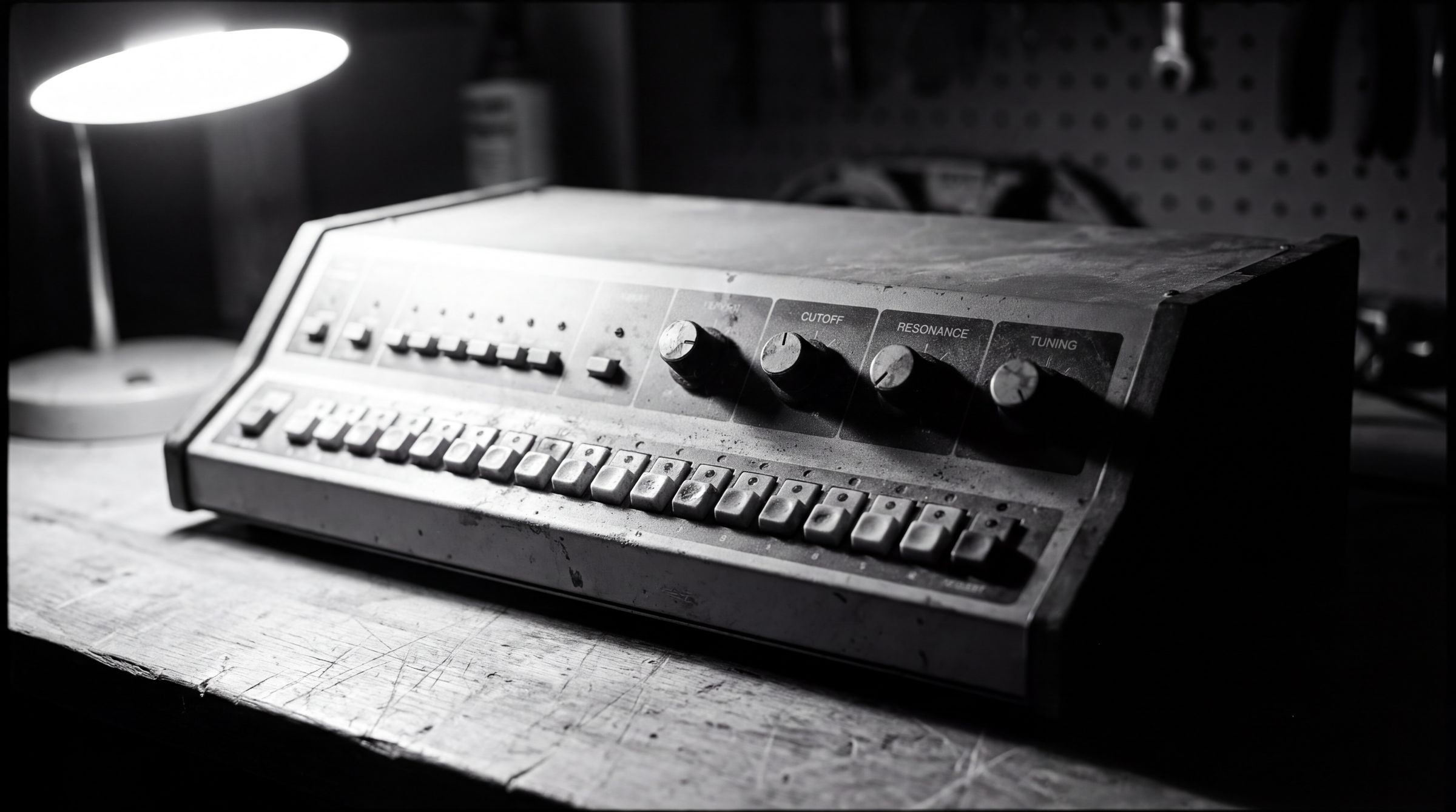
Roland discontinued the TR-909 in 1984, roughly a year after it shipped. Around 10,000 units, then the line went dark. By every measure the sales department used, the machine failed — out-marketed by the sampler, out-sold, made to look obsolete by the DX7’s digital sheen before it landed on a single hit record. Roland moved on.
The TR-909 is the kick drum under thirty years of house and techno.
That is not irony. It is a supply chain. And the moment you read it as a supply chain instead of a legend, the whole origin story of house music stops being romantic and starts being mechanical — which is the only way it is true.
Start with the failures, because there were three.
The TR-808 came first, 1980 into 1981, and underperformed on release. Too clean, too synthetic. Nobody wanted a drum machine that announced itself as a drum machine when a sampler could steal a real kit. The 909 followed in 1983 — analog kick, snare and toms, 6-bit samples driving the hi-hats and cymbals, MIDI on the back panel. Roland pitched it at working professionals who needed a convincing rhythm section. The professionals bought Linn drums and sampled real players. The 909 died on the shelf.
The TB-303 died worse. Released around 1981, sold as a “computer” — a bassline box that would replace the bass player for a guitarist practicing alone in a room. It failed at the one job it was built to do. A single oscillator through a 24dB-per-octave resonant low-pass filter, a step sequencer you programmed by typing in notes one at a time, two controls the manual barely explained: slide and accent. Nobody who heard it mistook it for a bass guitar, because it sounded nothing like one. It sounded like a wasp in a jar. Discontinued around 1984. A flop by any accounting.
Here is the mechanism the legend leaves out. Failure is what made them cheap.
A machine that sells becomes a used machine that holds its price. A machine that fails gets dumped — pawn shops, classified ads, a fraction of retail, nobody bidding. In Chicago and Detroit in the mid-80s, that is precisely what happened to these boxes. Kids with no studio budget could suddenly afford the exact gear professional studios refused to touch. The barrier to entry collapsed, not because anyone democratized anything, but because Roland had a warehouse problem and a broke teenager had twenty dollars.
Then somebody misused the wasp.
Phuture — Pierre, Spanky, Herb J — got hold of a secondhand 303 and did not read it as a bassline computer. They ran a sequence and turned the cutoff and resonance knobs while it played. The filter screamed and squelched and slid between notes, and the accent control — built to fake the dynamics of a human bass player — became a rhythmic wriggle no bass player had ever made. “Acid Tracks” came out of that around 1987. The sound was not designed. It was the residue of a broken tool in the hands of people with no reason to use it correctly.
That is the whole pattern. Larry Heard, a drummer by training, built “Can You Feel It” as Mr. Fingers in 1986 out of cheap Roland gear and made deep house before the phrase existed. Frankie Knuckles worked the floor at the Warehouse in Chicago — the club that gave the genre its name — cutting and extending tracks off a drum machine and a reel-to-reel. None of it required expensive equipment. All of it required the equipment to have failed first.
Run the counterfactual. If the 303 had worked — if it had convincingly replaced a bassist — it would have sold, held its value, and stayed in the gig bags of session players making records that sound exactly like what a bass is supposed to sound like. It made a genre precisely because it failed as a tool and got cheap enough for people with more ideas than money. The limitation was the design constraint. The constraint made the sound.
I trust this more than any spec sheet. Gear that does exactly what the brochure promised produces exactly what the brochure imagined — competent, on-brief, forgettable. Gear that fails leaves a gap, and someone with no budget and no reverence fills that gap with something the engineers never drew on the schematic.
Roland spent the 80s treating the 909 and the 303 as mistakes. The used market spent the same decade teaching the world what the machines were actually for. The kick that failed became the floor. The bass that failed became the acid. Failure did not slow house music down. Failure poured the floor it dances on.
More from this domain
4 Sept 2026
MusicPAF: The Pickup That Should Not Exist
Gibson printed the wrong patent number on its own legendary pickup for years. The PAF fails every modern QC test — and that failure is the tone.
3 Aug 2026
MusicThe Accidental Circuit
The Neve 1073 is the most worshipped preamp in recording, and the sound everyone chases is a defect its own designer set out to engineer away.
3 Jun 2026
MusicBuilding the Beast by Hand
I assembled an 80s superstrat part by part, period-correct, across three continents. Not because old is better. Because every spec is load-bearing.