
Building the Beast by Hand
I assembled an 80s superstrat part by part, period-correct, across three continents. Not because old is better. Because every spec is load-bearing.
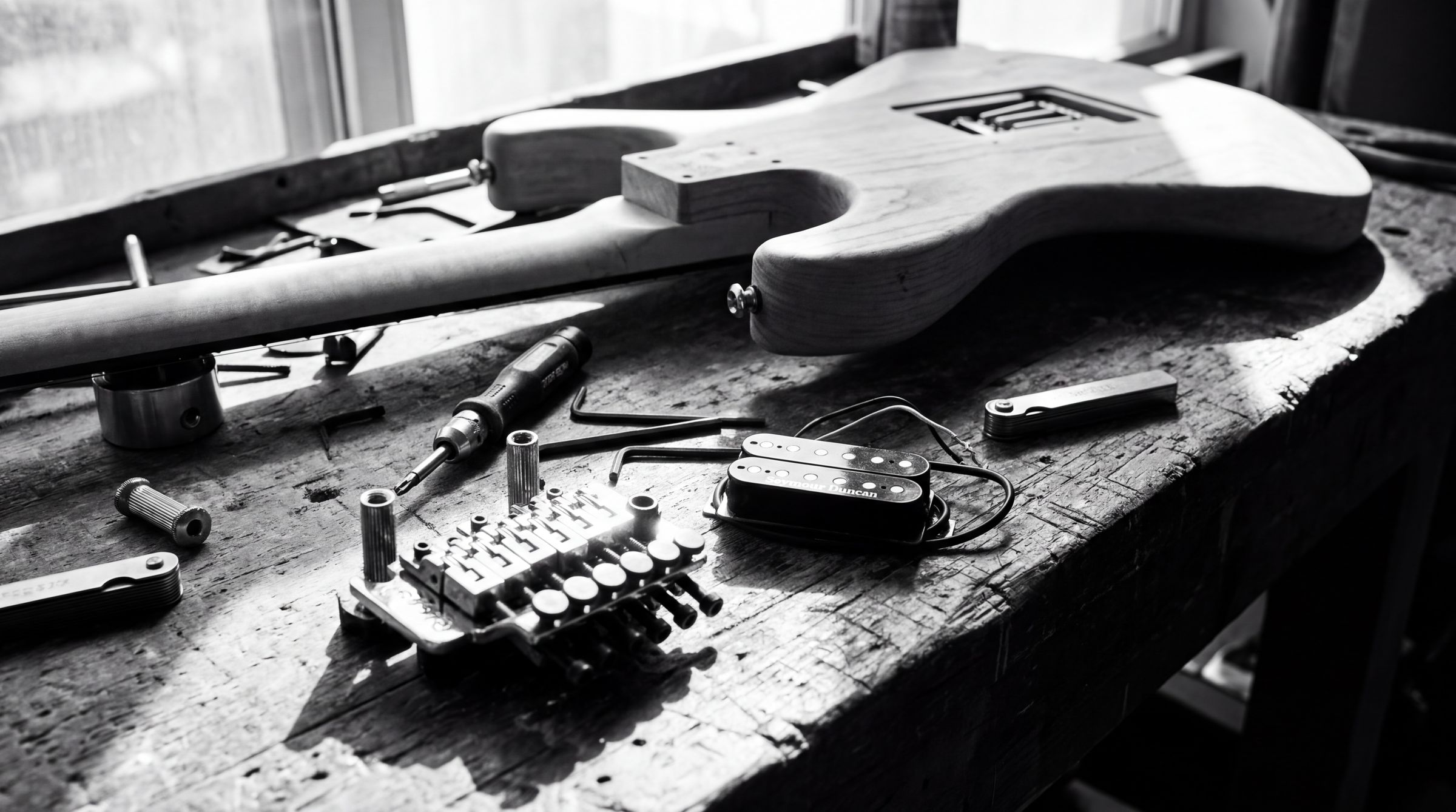
Walk into any guitar shop and pick up a “superstrat.” Basswood body. A licensed floating trem stamped with a brand that is not Floyd Rose. A ceramic bridge pickup wound hot enough to look impressive on a spec sheet. Every one of those choices is a shortcut, and every shortcut changes something you can measure. I spent this spring assembling one the other way — part by part, hunted across three continents — and the point was never that old is better. The point is that each spec is doing a job.
Start with the bridge, because the bridge is why the instrument exists.
The Floyd Rose
Floyd D. Rose filed US Patent 4,171,661 on January 3, 1977. Granted October 23, 1979. The claim was simple and violent: clamp the string at both ends. A locking nut at the headstock, locking saddles at the bridge, fine tuners to trim pitch once the clamps are down. Kramer began distributing the system shortly after the grant. Eddie Van Halen — credited by Floyd Rose directly — asked for the whole-step fine-tune range that made drop-D and dive-and-return possible without stopping to re-tune.
Here is what the double-lock actually does. Once you torque the nut, the tuning machines drop out of the circuit entirely. String tension is now balanced against the claw springs in the back cavity, and the bridge floats on two knife-edge posts. Pull up, dump down, land back at pitch. But a floating bridge breaks the coupling between string and body that a hardtail takes for granted. The string no longer terminates into a fixed block screwed hard to the wood. Something has to carry that lost sustain.
That is where the neck joint starts earning its keep.
The Neck Pocket
I sourced a period Charvel San Dimas neck. The USA San Dimas run carried serials 1001 through 5491, spanning 1981 to 1986 — roughly 750 earlier bolt-ons before that were built with no serial at all. What matters more than the number stamped on the plate is the heel. Standardized San Dimas production settled the heel width at a razor-tight 2 3/16 inches — a fit so close you drive it into the pocket, you do not drop it in.
Tight is not fetish. Tight is physics. Maximum wood-to-wood contact across the joint transfers vibration between neck and body, and on a guitar whose floating bridge has already surrendered the anchored coupling, that contact is doing double duty. The heel later crept toward 2 1/4 inches, but that arrived with the Pointy headstock further into the run — a shape change, not a day-one San Dimas spec. I built to the 2 3/16 figure because that is the era I wanted under my hand.
The Pickup
Bridge position: a Seymour Duncan SH-4 JB. 16.6k ohm DC resistance. Alnico 5 magnet. Four-conductor shielded lead.
Read those three numbers as a design, not a spec sheet. 16.6k is hot — high output that slams the front of a Marshall preamp into saturation without a boost pedal doing the work. The Alnico 5 magnet is stronger and tighter than an Alnico 2, so the low end stays focused and the upper mids cut instead of blur. That aggression is exactly what a floating trem needs, because the bridge softens attack a fraction and the pickup buys it back. The four-conductor lead is the versatility hedge: split the humbucker to a single coil and the guitar suddenly speaks Fender in the in-between positions. Gibson output, Fender snap, one flick of a switch. That is the entire superstrat thesis in one pickup.
The Body and the Nut
Period San Dimas bodies were not basswood. Opaque finishes ran on heavy northern ash, poplar, mahogany, or maple, often two pieces laminated. I chose ash under an opaque finish — dense, bright, with a fundamental that pushes back. Basswood is lighter and cheaper and goes soft in the low mids, which is why the mass market reaches for it and why I did not.
The locking nut is hardened steel. Not chrome-plate over pot metal — hardened steel, because the nut is one of two datum points on the whole instrument. The knife edges are the other. Both have to hold their geometry under repeated string tension or the tuning drifts and the dive-bombs stop returning to zero. Soft metal creeps. Hard steel bites and holds.
Five parts. Five decisions, each of which changes something you can hear or feel. The compromise superstrat on the wall gets close on paper and loses the plot in the wood, the magnet, and the joint. Vintage-correct is not the goal. Correct is the goal, and it happens to live in the old tolerances because someone worked these problems once and got them right.
More from this domain
4 Sept 2026
MusicPAF: The Pickup That Should Not Exist
Gibson printed the wrong patent number on its own legendary pickup for years. The PAF fails every modern QC test — and that failure is the tone.
3 Aug 2026
MusicThe Accidental Circuit
The Neve 1073 is the most worshipped preamp in recording, and the sound everyone chases is a defect its own designer set out to engineer away.
1 Jul 2026
MusicThe Floor Under House Music
The TR-909 and TB-303 were flops. That is the reason house exists — I can trace the whole genre to a supply chain of failed gear.