
The Wave That Never Reads You Back
A soliton is a wave engineered to never change. That is the point of Surf Ranch — and the exact reason it can teach a turn but never teach the ocean.
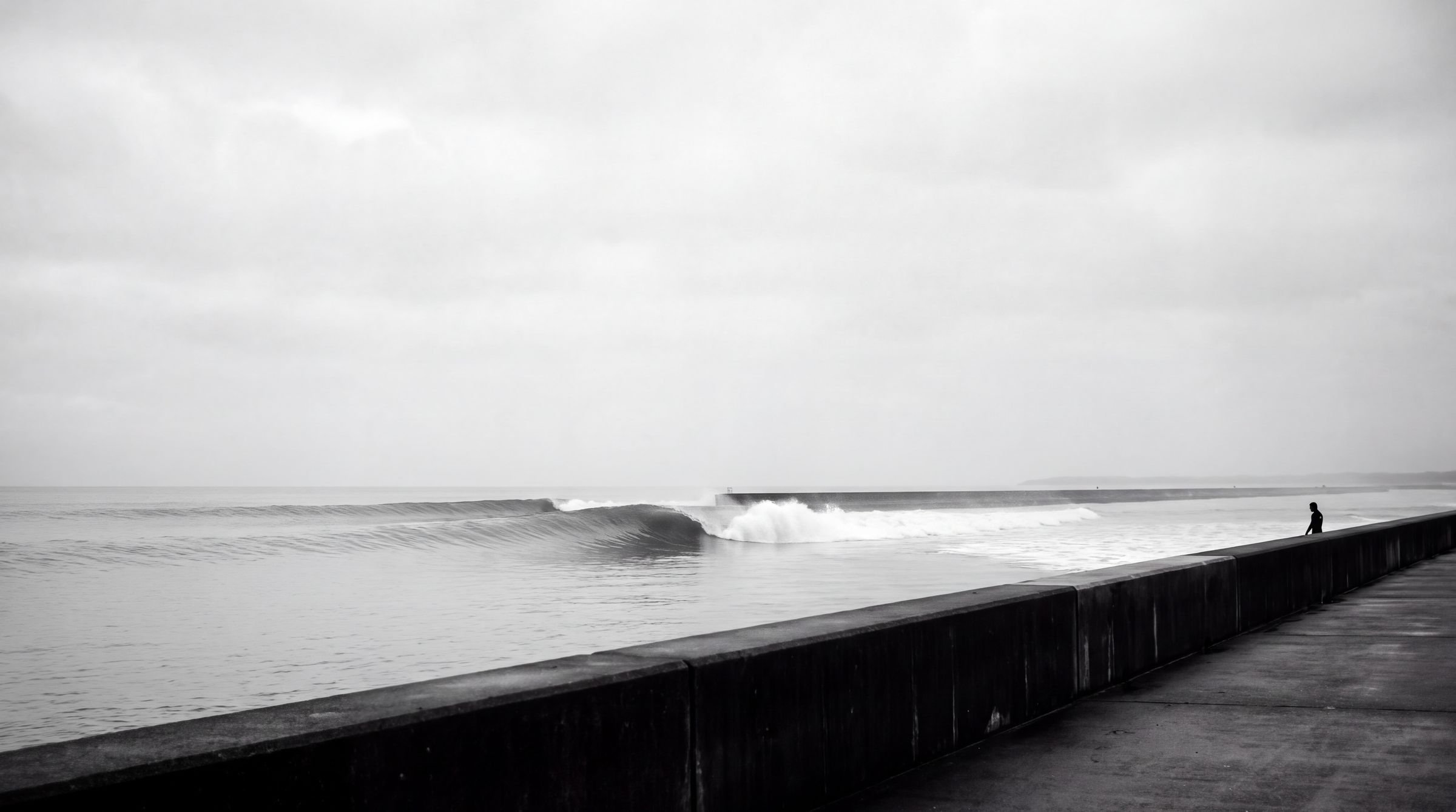
In December 2015 a video went out of Kelly Slater riding a wave that broke in a lake with no ocean anywhere near it. Lemoore, California. More than a hundred miles from the Pacific. The wave was flawless, and it was flawless again the next run, and the run after that, identical to the frame.
That sentence is the whole argument. Identical. The ocean has never produced two identical waves in its history, and it never will.
Here is what Adam Fincham actually built, described by the two men who built it rather than by the surf press. Slater set the brief: “It was [Fincham’s] job to figure out how to make that swell, and it was my job to figure out how to break that swell.” Fincham, a fluid-dynamics engineer, solved the making. The original 2008 patent application — US20100124459A1, Slater and Fincham as co-inventors — matured into granted US8,262,316 B2 in 2012; a later continuation, US9,546,491 B2, widened the claims to a linear channel, and a separate 2020 family, US10,597,884 B2, covers waves you can reshape and reverse. None of those documents names Surf Ranch or Lemoore. They describe an apparatus. The apparatus is a foil that moves water to the side, not upward, then pulls back to recover some of what it pushed away. What forms behind it is a Rayleigh solitary wave.
A soliton. That word carries the entire piece, so hold it.
A soliton is a wave that holds its shape as it travels. It does not disperse. It does not sort itself into a spectrum of periods the way a real swell does, the long-period energy outrunning the short. It does not meet a second wave train arriving late from a storm two thousand miles away and interfere into something neither storm intended. The soliton is the same wave at the start of the run down the channel and the same wave at the end. That is not a flaw Fincham failed to fix. That is the product. Fincham described it precisely: “We’ve got the perfect natural wave, and, well, that’s cool. But what about a supernatural wave that almost defies nature?”
Exactly right — and the naming of the problem sits right there inside the praise for the achievement. Defying nature is defying the one thing nature was doing.
I surfed Coxos this morning, mid-tide push, and the takeoff had moved fifteen metres north of where it sat last week — the sand shifts, the swell backed two degrees west, the reef stands a west swell up differently than a west-northwest one. I paddled for the first set half a beat late and it went without me. That is the ocean reading you back. It punishes hesitation. It rewards the commitment you make before you can fully see why. Every wave is a question posed in the two seconds before you stand — tide, period, sandbar, the wind that swung sideshore at ten — and your answer is graded instantly and without mercy. You get better because the question never repeats.
The pool removes the question. And that is genuinely useful. Strip out tide, wind, swell direction, crowd, and timing, hold every variable constant, and what remains is pure technique on a wave that will never surprise you. It is the cleanest training tool surfing has ever had. Fincham built the variability back in deliberately, tuning waves “for the level of the surfer, from a professional to a beginner” — knowing that a single perfect wave, repeated, teaches almost nothing after the tenth ride. Fincham called the annular design “very similar to a continuous point break,” and said the team tried to keep “the spirit of true surfing.” All true. All beside the point I care about.
Because a control group is not the experiment. It is what you subtract from the experiment to see what the variable was doing. Fincham spent a decade engineering the reading out of surfing, and in doing so proved, at enormous cost, exactly what the reading was for. The barrel was never the lesson. The negotiation was. The ocean asks something different every wave and you become a surfer by learning to answer a moving question in real time.
A machine wave gives you the answer and keeps asking the same one.
Ride the pool. It will sharpen your bottom turn, your timing off the top, your barrel positioning — all real, all measurable, all worth the ticket. Then paddle out at a real point on a shifting tide and understand that none of it taught you the actual skill. The wave that reads you back is the only kind that ever made a surfer. The one that holds its shape forever holds nothing else.
More from this domain
14 Jul 2026
OceanReading the Swell Before It Arrives
I check the 5am forecast half-asleep — and the math behind it was written in 1947 to put landing craft on a beach under fire.
26 Jun 2026
OceanThe Fin Setup Nobody Owns
Every board at Ribeira d'Ilhas ran three fins this morning. Mine too. Simon Anderson drew that setup in 1980 and never owned a cent of it.
25 May 2026
OceanThe 90s Toothpick Was a Destructive Test
The 90s toothpick era was not a fashion trend. It was a destructive test — every millimetre shaved to failure. Volume is the verdict.