
The 90s Toothpick Was a Destructive Test
The 90s toothpick era was not a fashion trend. It was a destructive test — every millimetre shaved to failure. Volume is the verdict.
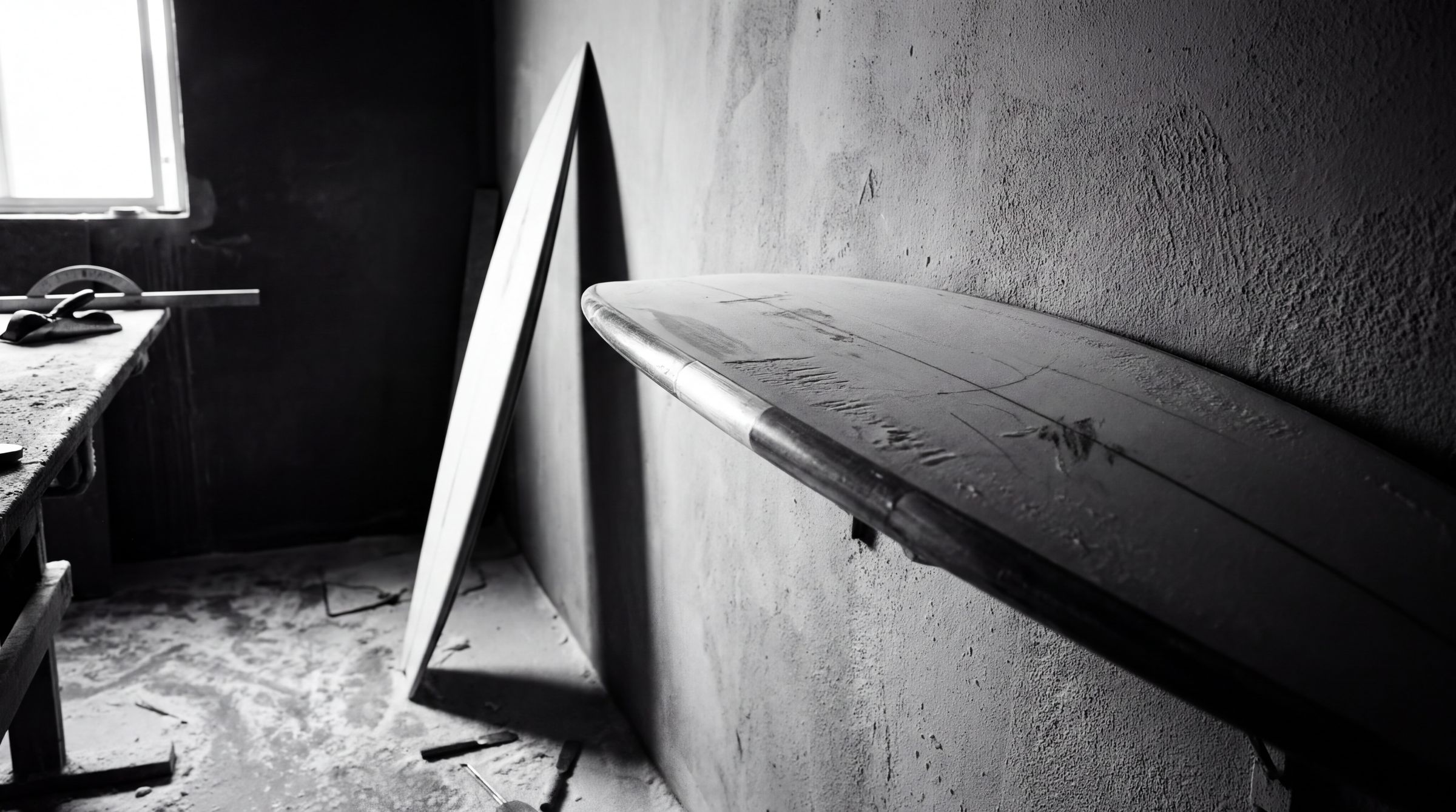
Kelly Slater’s early-90s Channel Islands board measured 6’1” long, 17 7/8” wide, 2 1/4” thick. Al Merrick shaped it. Years later Channel Islands handed that same board around for Red Bull’s Decades series and watched current pros fight it down the line. That is not a story about how good Slater was. It is a story about how narrow the target was.
The 90s toothpick era gets filed under fashion — a decade when boards went skinny because skinny looked fast. Wrong reading. It was a destructive test. Merrick started narrowing Slater’s shortboards under 18 inches wide in 1992, pulling foam out of the rails and stretching the rocker, tuning every shape tighter to one surfer’s weight and one surfer’s wave quality. By 1994 CAD/CAM shaping software arrived and the whole industry could copy those numbers to three decimals. So it did. The template cut for the best surfer alive, in the best waves on tour, went into production for everyone else.
What Thin Actually Bought
Give the era its due. Thin rails are not a mistake — they are a trade. A thin rail bites the face and releases fast, so the board goes rail-to-rail with almost no input. Less foam under the chest means less swing weight, which lets a surfer throw the tail vertical and bring it back before the lip lands. More rocker fits a tighter arc high in the pocket. For a light, explosive surfer standing in a Backdoor barrel, that sensitivity is the whole point. Slater did things on those boards nobody had done. The tool worked — for the hand it was cut for.
Then the same tool met the rest of us.
Where the Data Came In
Strip a board thin and you strip its paddle power. Foam is float, float is wave count, and a fine rail under a heavier chest sinks instead of planes. Stretch the rocker and you buy a tighter turn at the cost of everything down the line — more curve under the nose is more water to push, which bogs in anything soft or fat. Thinness kills momentum exactly where most surfers spend their sessions: waist-to-head-high, imperfect, gutless surf a board has to generate speed in, not just steer through.
I know it from the wrong end. Paddle a period-thin rail into a soft, waist-high Ericeira shoulder and you feel precisely where it quits — the board sitting low, planing late, the section closing out before the rail can find speed. That is not a skill gap. That is a volume gap, and no amount of pumping fixes a board that was cut for a body and a wave that are not yours.
Every failure was a measurement. Too little float — data. Too much rocker for the wave — data. A rail too fine to carry a real human’s weight through a flat section — data. As surf media later recounted, even Merrick admitted the rocker and the narrow outline “got a bit carried away,” that you can’t hand a 190lb guy a board designed for a 140lb guy.
The Verdict Is Volume
A modern performance shortboard is the lab report written up. Wider through the middle. Thicker through the stringer. Measured in litres now, because volume — not length — turned out to be the number that predicts whether a board works under a specific body. Matt Biolos saw it early and said so plainly: “early in the game of going back and exploring alternative, shorter, wider, flatter boards versus high performance needle noses in the early and mid ’90s,” in Biolos’s own telling. The industry took another decade to catch up, correcting through the mid-2000s toward the fuller shapes most people ride today.
The toothpick was never a failure. A failure teaches nothing. It was a controlled burn — every dimension shaved toward zero until the board stopped working, and the point where it stopped is the spec sheet everyone shapes from now. The thinnest boards ever made are the reason your board is thick.
More from this domain
20 Aug 2026
OceanThe Wave That Never Reads You Back
A soliton is a wave engineered to never change. That is the point of Surf Ranch — and the exact reason it can teach a turn but never teach the ocean.
14 Jul 2026
OceanReading the Swell Before It Arrives
I check the 5am forecast half-asleep — and the math behind it was written in 1947 to put landing craft on a beach under fire.
26 Jun 2026
OceanThe Fin Setup Nobody Owns
Every board at Ribeira d'Ilhas ran three fins this morning. Mine too. Simon Anderson drew that setup in 1980 and never owned a cent of it.