The Fin Setup Nobody Owns
Every board at Ribeira d'Ilhas ran three fins this morning. Mine too. Simon Anderson drew that setup in 1980 and never owned a cent of it.
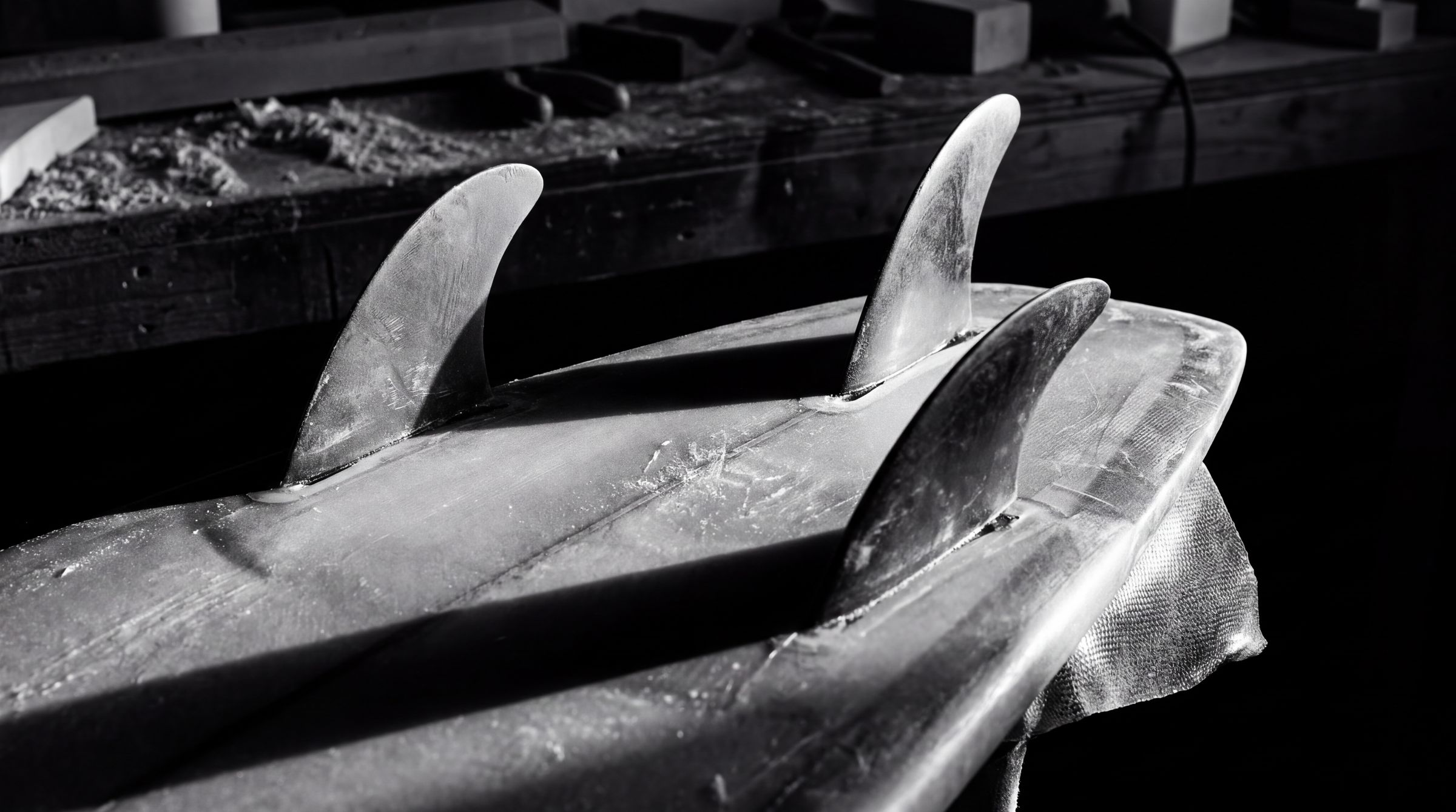
Every shortboard that paddled out at Ribeira d’Ilhas this morning ran the same fin setup. Three fins. Mine too — front pair toed in near the rail, a third standing up the centre of the tail, all three cut to the same size. It is so ordinary nobody names it. It has a name. Simon Anderson drew it in 1980, won on it through 1981, and never owned a cent of the most copied idea in surfboard history.
Anderson was a problem the equipment of the day could not hold. Around 200 pounds, powerful, driving off the tail harder than a twin-fin could take. Mark Richards was winning world titles on twin-fins, but a twin-fin under a heavy surfer slid out the back of a hard turn — loose exactly where Anderson wanted drive. A pin-tailed single-fin gave the drive and went stiff and slow as the tour moved to smaller waves. Anderson wanted both at once: single-fin drive, twin-fin looseness. Two properties that had always traded against each other.
The answer arrived in October 1980 at Narrabeen. Anderson saw a friend’s twin-fin fitted with a small trailing fin in the centre — Frank Williams, whose modified board, by Williams’ own later account, seeded the idea. What Anderson did next is the design. Not a twin-fin with a stabiliser bolted behind it. Not a Bonzer — Anderson had shaped one of those around 1974 and rejected it, too much fin clogging the water, dependent on channels cut into the bottom. Anderson made all three fins the same size, roughly four inches, set in a plain triangle: two toed in near the rails up front, one up the centre behind. No channels. No special bottom contour. No tooling nobody else had.
That simplicity is the whole story.
Anderson called it the Thruster — the third fin gave more drive, more thrust. And in 1981 the shaper proved it in the least forgiving way available: a professional contest, across days, as the swell fell apart underneath it.
Bells Beach, Easter. Anderson opened on the Saturday in massive surf — the surf museum’s own account puts it at four to six metres plus, double-to-triple overhead — riding a borrowed 6’6” shaped a couple of months earlier for another surfer, Steve Robertson. Won through it. Then the swell dropped, the way Bells swells do, and the final ran the next day in a fraction of the size down the point at the Rincon section — same headland, different reef, smaller and softer. Anderson switched to a shorter Thruster and won the final over Cheyne Horan. One contest. One design logic. Both ends of the wave-size range, days apart.
Then Anderson took the 2SM/Coca-Cola Surfabout in Sydney, and closed the year with the Pipeline Masters in Hawaii. Bells, Coke, Pipe — three venues, three wins, one fin cluster. The proof was not an argument. It was a season.
Here is where most inventors reach for a lawyer. Anderson reached for a planer and kept shaping. No patent was filed. Within roughly two seasons every serious manufacturer had a copy in production — by 1982, 1983, the three-fin was the shape of the sport. As Anderson has told it since, other people were working toward the same design anyway, and the shaper was content to have got there and contributed. Not resignation. A read of how the thing would actually spread.
And it is the correct read, because of that equal-fin simplicity. A patent protects what is hard to reverse-engineer. The Thruster was the opposite — three same-size fins in a triangle is legible to any shaper who holds the board once. No hidden channel geometry to license, no proprietary bottom contour, no jig only Anderson owned. The design was open architecture before software borrowed the phrase. Enforcement was never going to be the mechanism. Adoption was.
I feel the decision every time I change boards. Drop a twin-fin into a punchy Ericeira beach-break wall and it skitters loose off the top, fast and nervous, wanting to slide out. Put the same wave under a thruster and the tail bites and drives off the bottom, then breaks free exactly when I ask and not a beat before. That is Anderson’s two-properties-at-once, sitting under my back foot forty-plus years later, on a board built by a shaper who never paid a licence to make it.
This is the part the patent lawyers never understand. An idea locked up earns rent. An idea let loose becomes a standard. Anderson could have owned a fraction of the thruster and watched rivals route around it with 2+1 setups and near-copies. Instead the shaper owns the thing itself — the authorship, permanent, unenforceable, and total. The most valuable design in surfing is worth exactly nothing in royalties. That is not the price of a mistake. That is the price of winning.
More from this domain
20 Aug 2026
OceanThe Wave That Never Reads You Back
A soliton is a wave engineered to never change. That is the point of Surf Ranch — and the exact reason it can teach a turn but never teach the ocean.
14 Jul 2026
OceanReading the Swell Before It Arrives
I check the 5am forecast half-asleep — and the math behind it was written in 1947 to put landing craft on a beach under fire.
25 May 2026
OceanThe 90s Toothpick Was a Destructive Test
The 90s toothpick era was not a fashion trend. It was a destructive test — every millimetre shaved to failure. Volume is the verdict.