
The Room Is the Instrument
Andy Johns hung two ribbon mics in a stone stairwell and caught one of rock's most sampled drum sounds. The room is the first piece of gear in the chain.
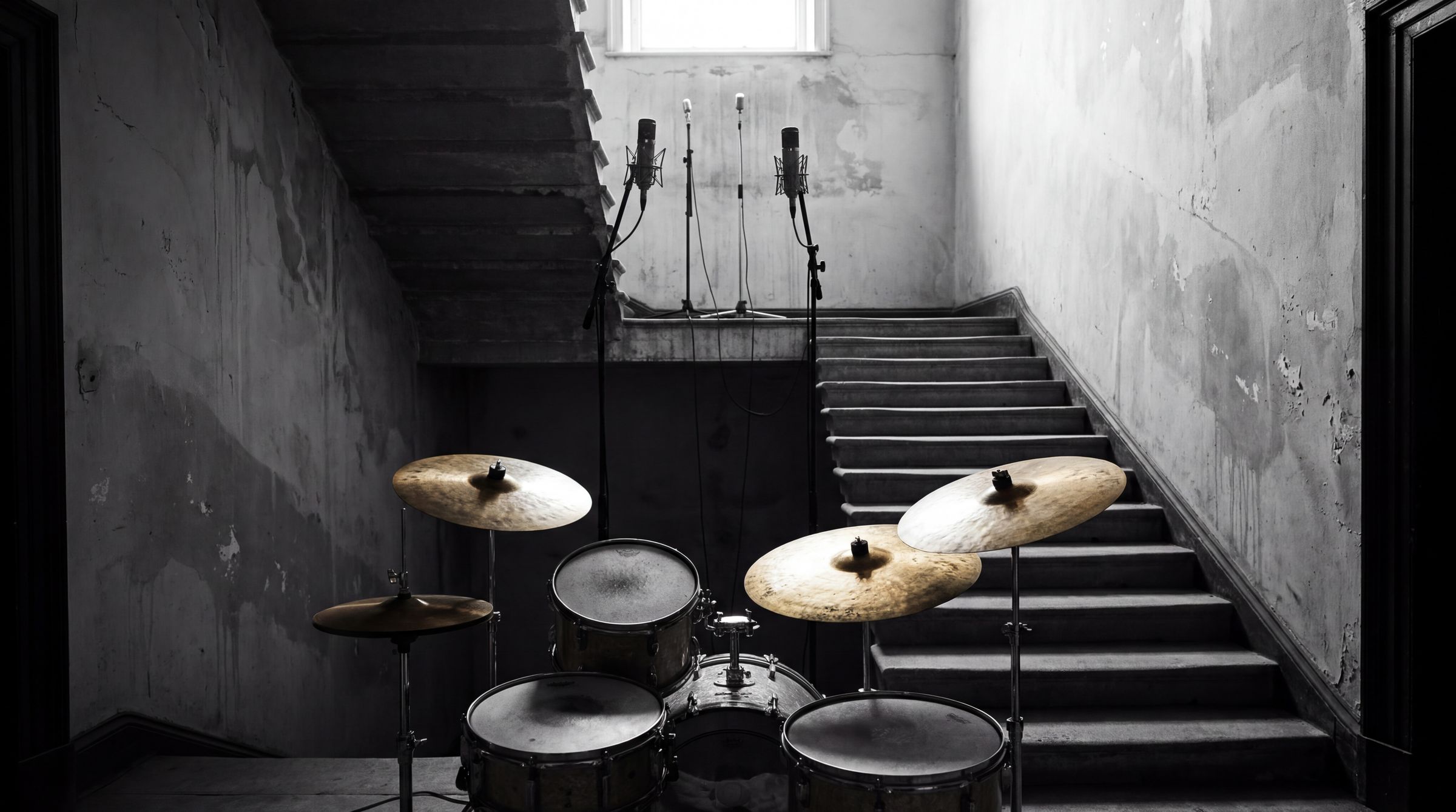
The drum sound on “When the Levee Breaks” is the most copied sound in rock, and almost nobody who copies it understands what they are copying. They think it is Bonham. It is the staircase.
Early 1971, Led Zeppelin decamped to Headley Grange, a cold Georgian house in Hampshire, and tracked most of the fourth album from the back of the Rolling Stones Mobile Studio parked in the drive. No purpose-built live room. No treatment. What the house had was a three-storey entrance hall with a stone staircase and hard plaster walls — a tall, reflective well with nowhere for sound to die. John Bonham set his Ludwig kit at the bottom of it. Andy Johns, engineering, hung two Beyerdynamic M160 ribbon mics on the landing above, pointed down into the well. Two microphones. No close mic on the kick, no mic per drum, no overheads in the way anyone would build a drum array today. Just a distant pair, high up, listening to the room.
That is the whole trick, and it was a decision, not an accident of budget.
Understand what a distant mic in a live room actually captures. A close-miked kick drum hears the beater and the front head and almost nothing else — that is the point of close-miking, isolation, the drum and only the drum. A ribbon hung three storeys up hears the beater, the front head, and every reflection the stone throws back over the next second and a half. The room adds weight the drummer never played. The decay is architecture. When Bonham hits the snare, the transient goes up the stairwell, slaps off the stone, and returns late enough to read as space and dense enough to read as size. Johns then ran that signal through a Binson Echorec for the delay and compressed it hard — but the compression only produced that famous heaving pump because the room had already handed him a long, dense tail to squeeze. Compress a dead, close-miked signal and you get a louder dead signal. Compress a room and you get weather.
This is the inversion most people never make. The signal chain does not start at the microphone. It starts at the source, and the very first thing the source hits is air, and the first thing the air hits is the walls. Everything downstream — capsule, preamp, converter, console, the entire Neve-and-tape argument — is processing a signal the room already shaped. The room is the first piece of gear in the chain. It runs before the mic. And it is the only piece you cannot swap in post.
Headley Grange is the famous case, but the principle built entire decades. Phil Spector’s Wall of Sound was made in the concrete echo chambers at Gold Star Studios — the reverb printed onto the tape before a single overdub, a physical room feeding the sound. Ten years after Zeppelin, Hugh Padgham caught Phil Collins’s kit through the SSL console’s talkback compressor in the stone room at the Townhouse in London, gated the tail, and the gated-reverb drum sound of the entire 1980s fell out of one reflective room and one signal path. Different rooms, different eras, same lesson: the space did the work that the gear got credited for.
Now watch what happened when the industry decided the room was a problem. Close-mic everything, isolate every source, kill the bleed, print it dry, and add the space back afterward with a plate or a spring or a Lexicon PCM70 or a convolution plug-in. Total control. And the drums went flat. A reverb algorithm bolts a room onto a signal that never stood in one — it adds an impression of space to a sound that was recorded fighting space. It never breathes the same way, because the source never actually moved air in a room. The dimension is painted on. You can hear the difference in a second, even if you cannot name it: the sampled Bonham loop against the real one, the plug-in reverb against the stairwell. One is a photograph of a room. The other is a room.
I have spent years chasing tone through Les Pauls, cranked Marshalls, and racks of converters, and the single most violent change I can make to a recorded sound is not a pickup swap or a tube swap. It is moving the cabinet. A JCM800 4x12 in a carpeted bedroom and the same cabinet in a tiled garage are two different amps. The speaker did not change. The air did.
Andy Johns did not fix the room in post. He aimed two ribbons into a stone stairwell and pressed record, and the building played the loudest part.
The room is not where you record the instrument. The room is the instrument. Everything else is a microphone pointed at it.
More from this domain
4 Sept 2026
MusicPAF: The Pickup That Should Not Exist
Gibson printed the wrong patent number on its own legendary pickup for years. The PAF fails every modern QC test — and that failure is the tone.
3 Aug 2026
MusicThe Accidental Circuit
The Neve 1073 is the most worshipped preamp in recording, and the sound everyone chases is a defect its own designer set out to engineer away.
1 Jul 2026
MusicThe Floor Under House Music
The TR-909 and TB-303 were flops. That is the reason house exists — I can trace the whole genre to a supply chain of failed gear.