
Why I Don't Need 20 Lenses
The lens industry sells preparation. What photographers actually need is commitment to a single field of view.
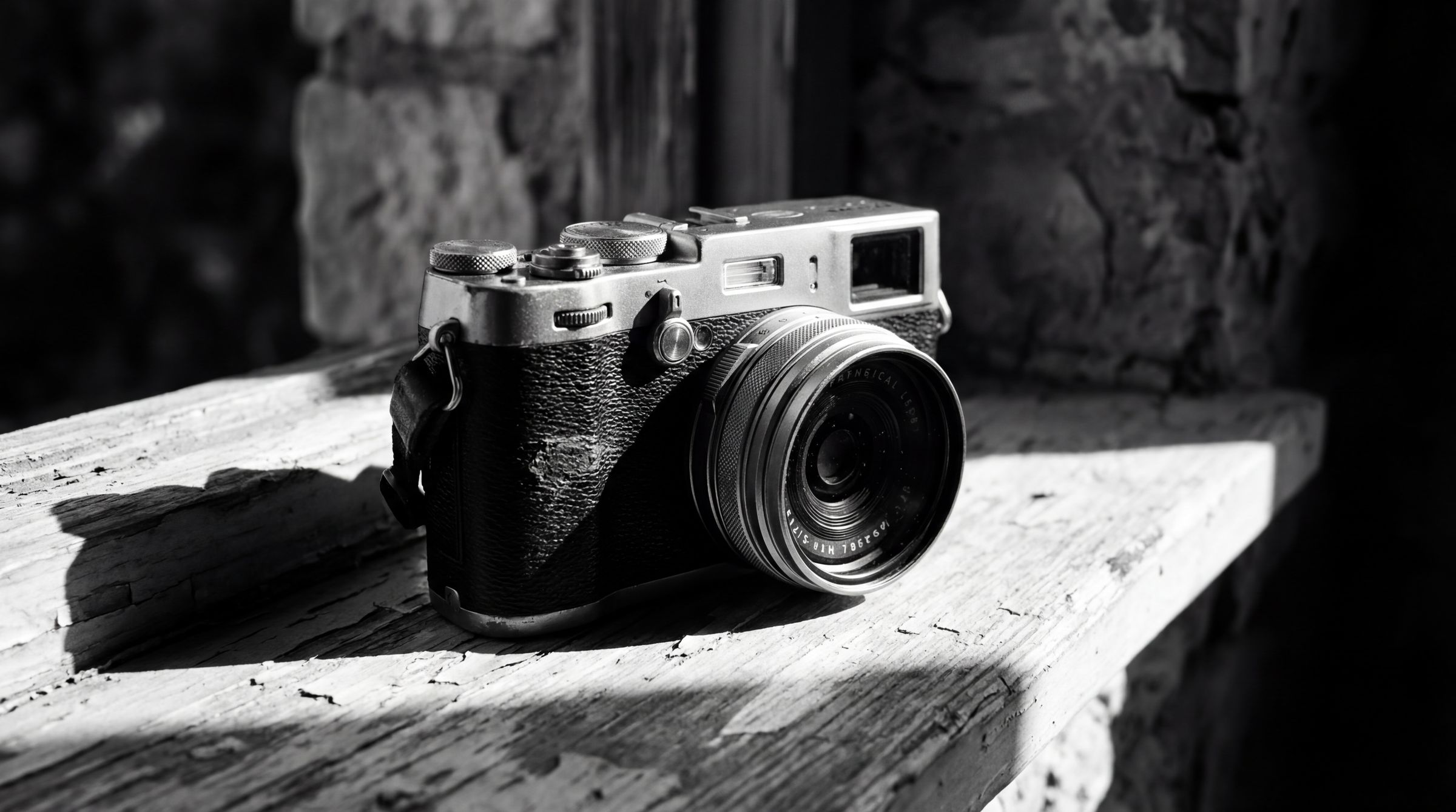
Fujifilm currently sells twenty-nine XF and XC lenses for the X-mount system. Sony offers forty-plus for E-mount. Canon’s RF lineup sits past forty and keeps growing. Each new release arrives with a media cycle: pre-announcement leaks, spec-sheet analysis, pre-order links, review embargoes, sample galleries, YouTube comparisons at 100% crop with charts overlaid on brick walls. The entire apparatus exists to convince you that the photograph you haven’t made yet is waiting inside a lens you haven’t bought yet.
I own one. The Fujinon XF 35mm f/1.4 R. Mounted on a Fujifilm X-E5, APS-C sensor, 1.5x crop — 53mm equivalent field of view. The rear lens cap disappeared years ago. The thought of swapping glass mid-shoot does not occur to me.
The industry calls the compulsion to accumulate lenses GAS — Gear Acquisition Syndrome. The name makes it sound like a personality quirk. It is not. It is a manufactured dependency, engineered at every level of the photography food chain — manufacturers feed on your attention and excrete marketing. New lens, new review cycle, new reason to visit the store. The customer who owns one body and one prime is a failed conversion. The customer who owns one body and six lenses is a success story.
Here is what the marketing never mentions: every additional lens in your bag is a decision you have to make before you see the photograph. Wide or standard. Zoom or prime. Fast aperture or light weight. The decision tree grows with each piece of glass. And every second spent choosing is a second not spent looking.
I watched this play out at a street photography walk in Lisbon last year. Twelve photographers, various kits. The ones with multiple lenses spent visible time at each corner evaluating focal length. Bag open, lens compared, decision made, bag closed, camera raised. The sequence took fifteen to twenty seconds at every new scene. In twenty seconds on a street corner, three expressions change, one shaft of light shifts, and the frame that existed when you started choosing is gone.
The single-lens photographers — there were two of us — were already shooting.
This is not a constraint argument. I wrote about constraint as a creative principle elsewhere, across surfing and music and photography. This is more specific. This is about what you learn when a single focal length becomes your permanent field of view.
Seven years on the XF 35mm f/1.4 at 53mm equivalent taught me things no lens swap could. I learned subject distance in my legs. A head-and-shoulders portrait: two meters. A three-quarter body shot: four meters. Full-length with environment: six to seven meters. I don’t estimate anymore. I walk to the distance that gives me the frame, the way a guitarist’s left hand finds the fret without looking after enough years on the neck.
I learned the optical personality of this specific piece of glass. Wide open at f/1.4, the rendering is soft at the edges — not clinically sharp in the way a modern f/1.2 aspherical design would deliver, but with a character in the out-of-focus areas that reminds me of older lenses. The bokeh has texture. It swirls slightly in the midground at close focus distances. Stopped down to f/5.6 or f/8, the lens gets surgical — edge-to-edge sharpness that rivals glass costing three times as much. The transition between these two behaviors — soft-wide to sharp-stopped — is the entire tonal range of the instrument. Like knowing what a Les Paul does clean versus what it does through an overdriven JCM800.
I learned that “I need a wider lens” almost always means “I need to take three steps back.” And “I need a longer lens” almost always means “I need to get closer.” The photographer who reaches for a different focal length is often the photographer who hasn’t committed to a position — physical or compositional.
The phrase “the right lens for the situation” sounds like competence. It is actually a confession. It means the photographer’s vision is subordinate to the equipment list. It means the scene is dictating the tool rather than the photographer’s intention dictating the frame. Lindbergh shot Linda Evangelista and Tatjana Patitz and Christy Turlington on the beaches in Malibu with the same camera and the same lens, season after season. The location didn’t change. The light didn’t change. The photographs changed because Lindbergh changed — his eye sharpened, his distance shifted, his patience deepened. He didn’t need new glass. He needed more hours behind the viewfinder.
The review-industrial complex survives because photographers are trained to see equipment as capability and limitation as obstacle. A new 16mm f/1.4 launches. Reviews cover its performance for environmental portraits and low-light interiors. The forums fill with sample images. The credit cards come out. Nobody writes the review that matters: what would happen if you kept your current lens for another two years and forced yourself to solve the problem with your feet, your timing, and your eye.
That review would cost the industry revenue. It would also produce better photographers.
I don’t need twenty lenses. I don’t need two. The Fujinon XF 35mm f/1.4 R sees what I see, at the distance I think. Everything after that is movement, light, and the willingness to commit to a frame before the moment dissolves.
The best lens is the one you stop thinking about.
More from this domain
25 Aug 2026
PhotographyThe Case for Printing
The screen is a proof. The print is the photograph. An image that only ever lived on glass is unfinished work — a mix you never bounced.
24 Jul 2026
PhotographyHow to Read Light
Reading light is a trained skill, not luck. You see the finished frame before you raise the camera — the same way you read a set before it stands up.
16 Jun 2026
PhotographyThe GFX Question
The GFX 100S is not a better X-E5. It is a different instrument, and I keep the X-E5 anyway.