A Great Fish Can Do Everything
A 5'8" twin-fin fish at 34 litres handles waist-high mush and overhead walls. Most surfers dismiss it as a small-wave toy. They are wrong.
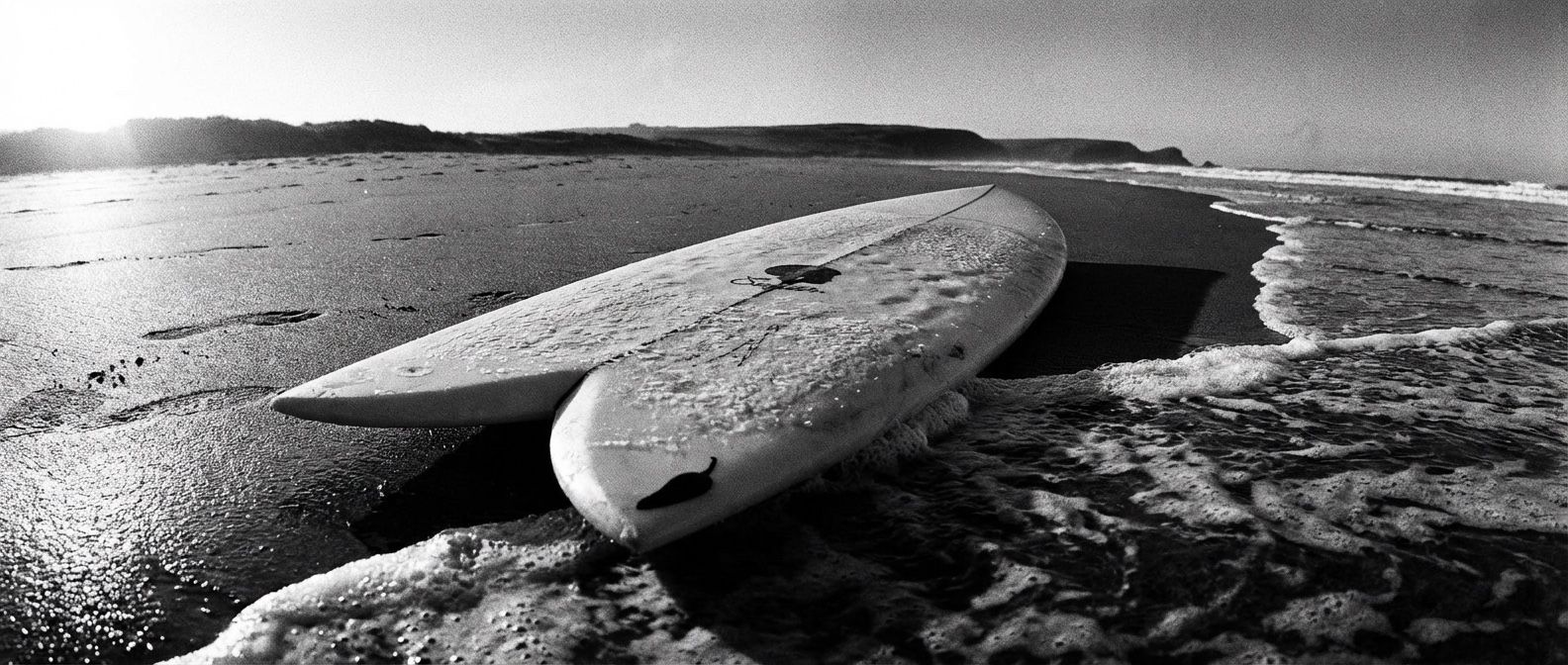
I took the fish out in overhead, offshore, late-afternoon glass last Thursday. Ribeira d’Ilhas, the right-hander that breaks over reef and cobblestone and rewards commitment. Most of the lineup was on shortboards and mid-lengths. I was on a 5’8” twin-fin, 21” wide, 2 5/8” thick, 34 litres, flat entry rocker with a deep swallow tail. Three guys in the channel told me I had the wrong board.
I caught more waves than anyone in the water.
The Design That Generates Speed
The twin-fin fish is the only surfboard shape that creates speed from the wave itself rather than demanding it from the surfer. The physics are straightforward. Flat rocker through the entry means the board sits on the water rather than in it — the planing surface is maximised, the drag is minimised. The wide outline carries volume through the middle of the board, providing paddle power that rivals boards a foot longer. The swallow tail splits the water release into two points, reducing suction and allowing the board to accelerate through flat sections where narrower tails would stall.
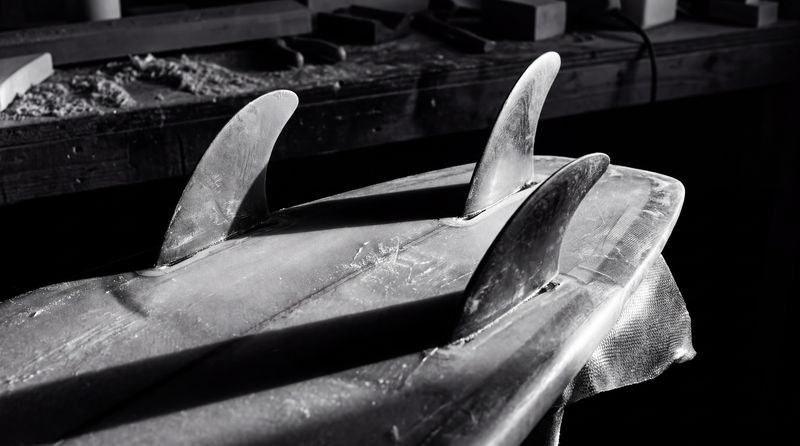
Twin keel fins — upright, raked, with a flat inside face and a foiled outside — release water differently from a thruster setup. Three fins hold. Two fins release. The difference is directional freedom. A thruster fin cluster creates resistance through the turns, which provides control but taxes speed. Twin keels let the tail slide and project, converting every degree of the wave face into forward motion.
On a waist-high, slow, mushy day, this speed generation is obvious. The fish flies where shortboards bog. What most surfers do not understand is that the same physics apply when the waves get bigger.
The Overhead Argument
In overhead surf, the fish does three things that change the session.
First, it paddles into waves earlier. At 34 litres, the board catches waves two strokes before the 24-litre shortboard next to you. In a crowded lineup, that priority is everything. Earlier entry means a higher position on the wave face, which means more energy at takeoff, which means more speed down the line.
Second, the flat rocker holds on steep faces better than its reputation suggests. The entry rocker on a well-shaped fish is not a uniform flat plane — it transitions through a subtle convex bend behind the front foot, which prevents the nose from catching on steep drops. The tail rocker is slightly kicked compared to a small-wave fish, enough to release on turns without losing the drive that defines the shape. A good shaper builds this transition for the surfer’s weight and the wave range. A cheap fish is a flat plank. A great fish is a tuned instrument.
Third, the speed surplus changes what is possible on the face. On a shortboard, overhead sections require pumping to maintain speed through the transition between bottom turn and top turn. The fish carries speed through the bottom turn without pumping. The wide planing surface and twin-fin release create momentum that a thruster has to manufacture. The result is a bottom turn that flows into a trim that flows into a direction change — a continuous line, not a sequence of moves.
The Constraint Advantage
The fish does not turn like a shortboard. It never will. The twin-fin setup does not snap off the top. It does not go vertical. It does not allow the kind of radical direction changes that define competitive shortboarding.
That is not a limitation. That is the design.
The fish asks a different question of the wave. Not “what can I do to this wave?” but “where does this wave want to go, and can I stay in the pocket while it takes me there?” The drawn-out bottom turns, the long rail lines, the speed through sections that would close out on a slower board — these are not compromises. They are the point.
Every surfer who rides a fish for the first time says the same thing: I did not know the wave had that section. The speed reveals parts of the wave that slower boards never reach. Sections that close out on a shortboard become makeable on a fish because you arrive with speed to burn. The wave does not change. The board changes what you see in it.
One Board
I wrote about the quiver as vocabulary. Three boards, three conversations. I still believe that. But if someone forced me to ride one board for a year — any break, any size from knee-high to double-overhead — I would take the fish without hesitation.
The shortboard gives you the last twenty percent of radical performance. The fish gives you the first eighty percent of every session, in every condition, with half the effort and twice the waves caught. The mathematics are not close.
Same logic as owning one lens. The 50mm does not do everything. But it does enough that the constraint becomes the teacher, and the teacher becomes the style. The fish does the same thing in the water. Ride it long enough and your surfing changes — slower, smoother, more connected to the wave’s energy instead of fighting it.
A great fish can do everything that matters. The things it cannot do are the things you did not need.
More from this domain
20 Aug 2026
OceanThe Wave That Never Reads You Back
A soliton is a wave engineered to never change. That is the point of Surf Ranch — and the exact reason it can teach a turn but never teach the ocean.
14 Jul 2026
OceanReading the Swell Before It Arrives
I check the 5am forecast half-asleep — and the math behind it was written in 1947 to put landing craft on a beach under fire.
26 Jun 2026
OceanThe Fin Setup Nobody Owns
Every board at Ribeira d'Ilhas ran three fins this morning. Mine too. Simon Anderson drew that setup in 1980 and never owned a cent of it.