
Less Buttons for Better Pictures
The X-E5 has dials where other cameras have menus. The exposure is set before the shot, not fixed after. That sequence changes everything.
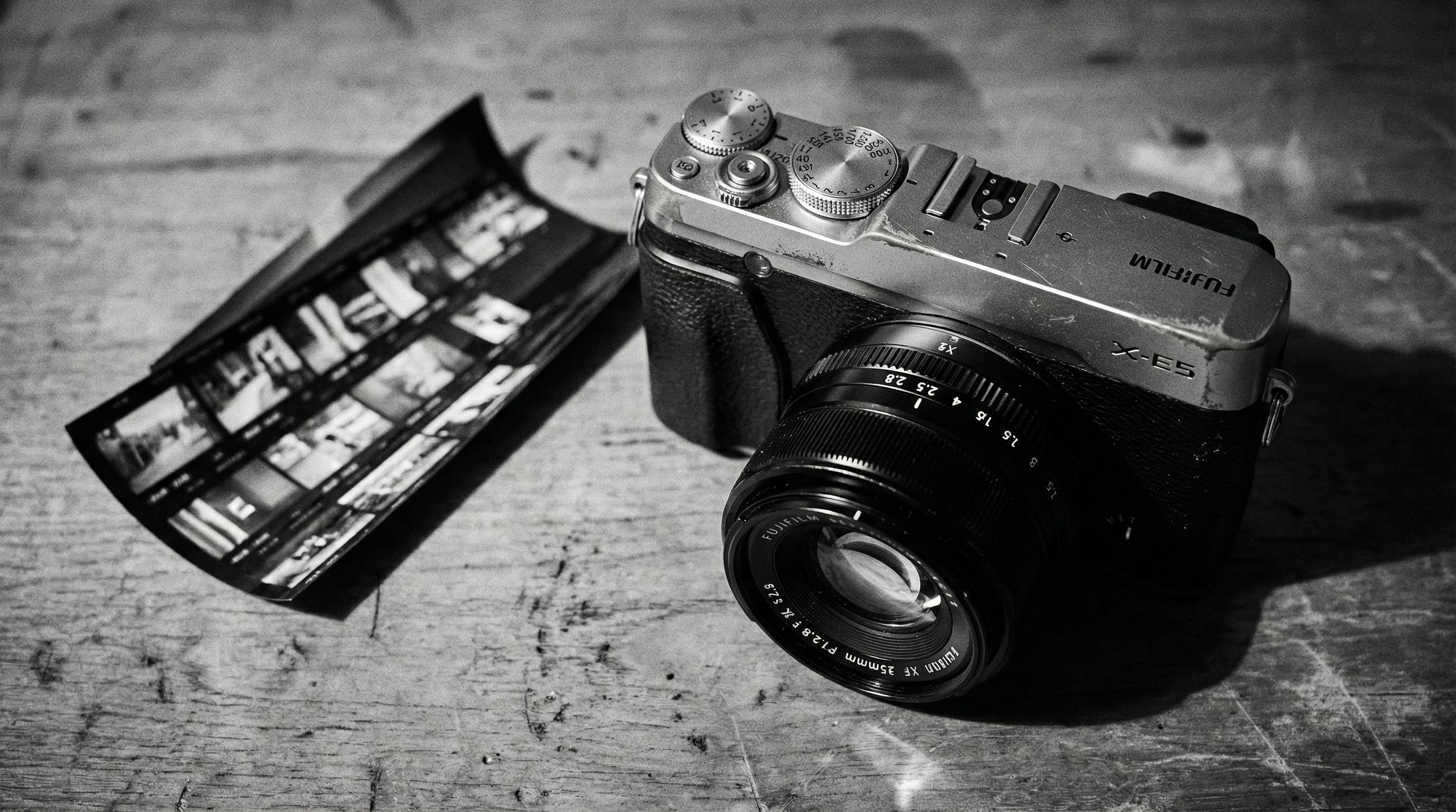
The Fujifilm X-E5 has a shutter speed dial on the top plate. You twist it with your thumb and the number clicks into position — 1/500, 1/250, 1/125. Mechanical, tactile, irreversible until you twist it again. Next to it, a Film Simulation dial — Provia, Velvia, Astia, Classic Chrome, Acros, six positions you set by touch. On the lens, an aperture ring with third-stop detents. Exposure compensation, another physical dial. The exposure triangle lives on the body and the lens, set before the camera comes up to your eye.
Most modern cameras bury these settings behind button presses, scroll wheels, and touchscreen menus. Change ISO on a typical mirrorless body and you press a button, spin a dial, confirm on screen. Three actions instead of one. Exposure compensation requires navigating a custom function menu unless you have assigned it to a programmable dial — which itself requires navigating a setup menu. The settings exist. The path to them is administrative.
This is not a usability complaint. It is a photographic argument.
Decisions Before the Frame
When exposure controls are physical and always visible, you set them before you shoot. Walking toward a scene, you glance at the top plate — shutter at 1/250, ISO at 400, aperture at f/2.8. The exposure triangle is decided before the viewfinder touches your eyebrow. When the moment arrives, you raise the camera and press the shutter. One action. The photograph happens at the speed of recognition.
When exposure controls are menu-driven, the sequence inverts. You raise the camera, see the scene, then adjust. The moment is already in front of you and you are scrolling. The photograph happens at the speed of administration. The difference is a fraction of a second. That fraction is where the best frames live.
Peter Lindbergh shot on cameras with mechanical controls — shutter speed dials, aperture rings, manual focus. The exposure was committed before the interaction with the subject began. When Lindbergh raised the camera, he was not adjusting settings. He was watching the face. The camera was already set. His attention was entirely on the person. That allocation of attention — toward the subject, away from the machine — is what made his portraits feel honest. The camera disappeared from the process.
The Chimp Trap
Menu-driven cameras encourage chimping — take the shot, check the rear screen, adjust, take another. The feedback loop feels productive. You are iterating. You are optimizing. You are also training yourself to trust the screen instead of your eye. Over time, chimping erodes previsualization. You stop anticipating the exposure because the screen will tell you whether you got it right. The machine becomes the judge. Your eye becomes the passenger.
With dials, there is no review loop. The exposure is set by feel and experience. You know that overcast sky at midday is ISO 400, f/5.6, 1/250 because you have dialled it in a thousand times. The fingers know. The same way a guitarist knows the neck position of a Les Paul produces a warmer tone without looking at the toggle switch — the hand has been there so many times that the decision is muscular, not cognitive.
The X-E5 has no mode dial. No P, no S, no A, no M stamped on a rotating selector. The “mode” is a consequence of the dials. Set shutter speed to A and aperture to a number — that is aperture priority. Set both to specific values — that is manual. The camera does not ask you to declare a mode. You declare an exposure. The distinction is subtle and total.
The Reduction Argument
Modern cameras add features because the market demands specifications. More autofocus points, more frames per second, more video resolutions, more custom function banks. Each feature adds a menu item. Each menu item adds a decision. Each decision adds distance between the photographer and the photograph.
The X-E5 strips that distance. The controls you need are on the body and the lens. The controls you do not need are absent. The film simulations — Provia, Velvia, Acros — are accessed through a physical dial on the top plate, not a submenu. The camera is configured by touch, not by navigation.
Less surface. Less friction. Less between the eye and the frame.
The best photographs are not products of the most capable machines. They are products of the clearest attention. Every button you do not press is attention you do not spend. Every menu you do not navigate is a moment you stay present. The X-E5 does not make better pictures. It makes a better photographer. The camera gets out of the way. The work begins.
More from this domain
25 Aug 2026
PhotographyThe Case for Printing
The screen is a proof. The print is the photograph. An image that only ever lived on glass is unfinished work — a mix you never bounced.
24 Jul 2026
PhotographyHow to Read Light
Reading light is a trained skill, not luck. You see the finished frame before you raise the camera — the same way you read a set before it stands up.
16 Jun 2026
PhotographyThe GFX Question
The GFX 100S is not a better X-E5. It is a different instrument, and I keep the X-E5 anyway.