
Slash: Controversial, but Absolute Legend
A vintage-output pickup into a cranked Marshall. The mismatch between the spec and the sound is the entire argument for feel over precision.
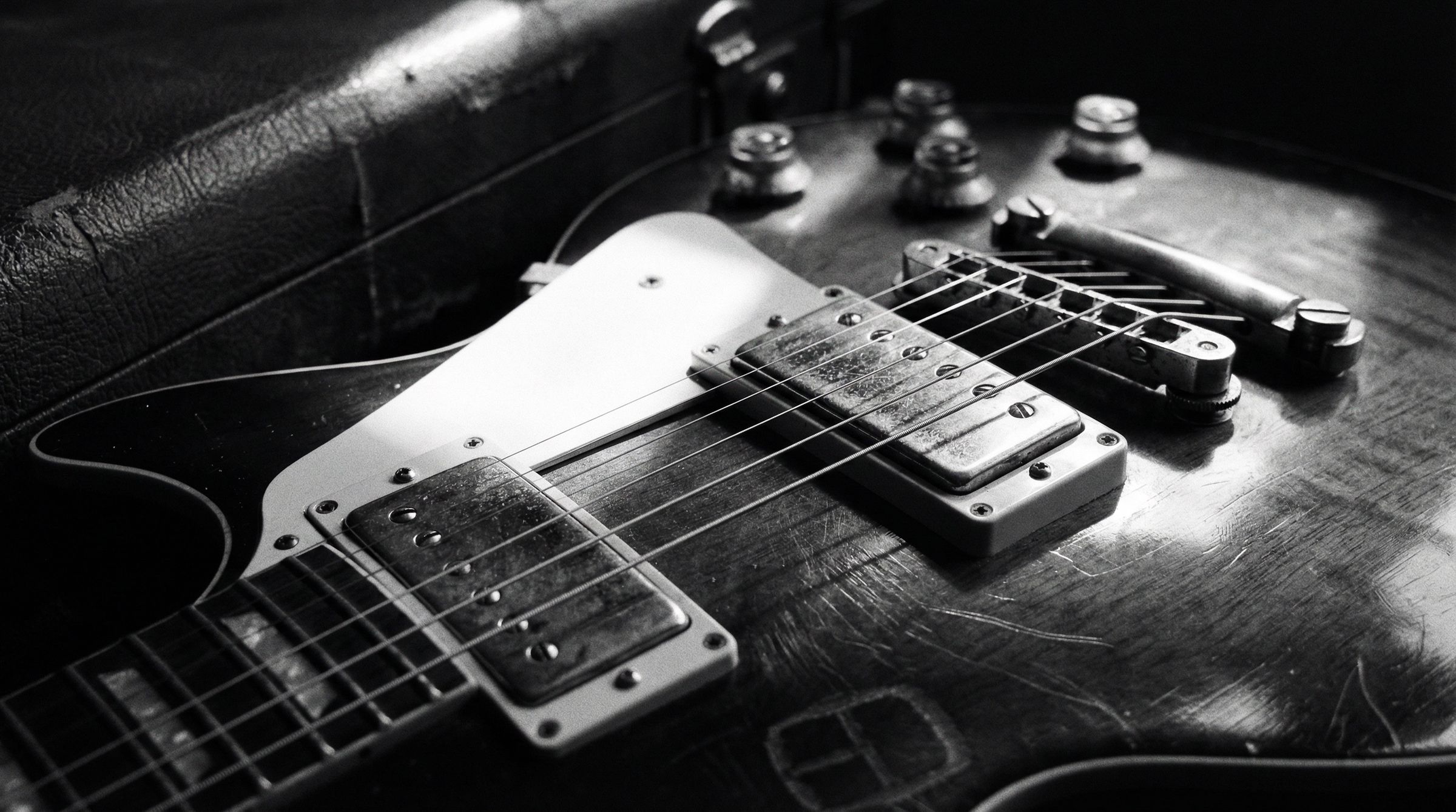
The Seymour Duncan Alnico Pro II measures 7.9 kΩ at the bridge position. That is vintage output — roughly the same impedance as a 1957 PAF, designed to sound warm, open, and responsive to picking dynamics. It is not a high-gain pickup. It was not designed for the kind of saturation that melts stadium walls.
Slash put it in a Les Paul Standard, ran it into a Marshall JCM800 2203 with the preamp gain past seven, and recorded Appetite for Destruction. Over 30 million copies sold. The opening riff of “Sweet Child O’ Mine” — casual noodling that Izzy Stradlin started playing chords behind and Axl Rose pushed into a full song — became one of the most recognized guitar phrases on the planet. The pickup was too quiet for the job. That is why it worked.
A hot pickup compresses the signal before it hits the amp. The dynamics flatten. The attack softens. Everything sounds urgent but nothing sounds alive. The Alnico Pro II does the opposite — it sends a clean, uncompressed signal into the Marshall’s preamp stage and lets the amp do all the work. The distortion happens in the tubes, not in the pickup. The result is a tone that responds to how hard Slash hits the string. Dig in and the note screams. Back off and it cleans up. The dynamic range is enormous because the pickup is not pre-cooking the signal.
This is the part the shredders miss.
Slash has never been a technical guitarist by conservatory standards. His bends overshoot by a quarter-tone. His vibrato is wide and aggressive — closer to B.B. King than Yngwie Malmsteen. His timing sits behind the beat, dragging phrases across the bar line in a way that creates tension a metronome would call wrong. He plays with a looseness that looks sloppy on paper and sounds inevitable on tape.
The “November Rain” solo is not fast. It is not technically complex. It is a melody — a vocal line played on a guitar, with bends that ache and sustain that decays at exactly the rate a human breath would. Slash does not play the guitar like a guitar. He plays it like a voice. The instrument sings because he refuses to let technique interrupt the sentence.
That is why he is controversial. The technical community looks at his playing and sees imprecision. The shredders — and I have built superstrats with Floyd Rose bridges and compound-radius fretboards specifically to facilitate the kind of speed Slash never chases — measure guitar playing by note density and execution accuracy. By those metrics, Slash loses to any Berklee graduate with a practice routine.
But nobody hums a Berklee exercise. Everyone hums “Sweet Child O’ Mine.”
The gear tells the story. The Les Paul Standard — heavy, thick-necked, resistant to speed. The Alnico Pro II — low output, wide dynamic range, punishes lazy picking. The Marshall JCM800 — a single-channel amp that does not offer a clean-to-dirty toggle; you commit to the gain level and work everything else with your hands. Later, the Silver Jubilee 2555, which adds a second channel but retains that same Marshall midrange bark that cuts through a wall of sound without EQ surgery.
Every piece of this rig rewards feel over speed. The guitar slows you down. The pickup demands dynamics. The amp responds to touch. Slash did not stumble into this combination. He found the tools that matched how he hears music — in phrases, not in patterns, with weight behind every note instead of volume through every bar.
The controversy is a category error. Evaluating Slash by technique is measuring a poet’s vocabulary count and concluding that Shakespeare used too many common words. The metric is wrong. The unit of measurement for Slash is not notes per second. It is conviction per note.
Appetite for Destruction was produced by Mike Clink at Rumbo Recorders and other Los Angeles studios in 1987. It remains one of the highest-selling debut albums in history. The guitar tone on that record — warm, overdriven, vocal — has been chased by boutique amp builders for nearly four decades. Most of them are using pickups with twice the output and missing the point by exactly that margin.
A moderate pickup into a cranked amp. A player who values the phrase over the technique. A sound that works because the components are mismatched by spec and perfectly matched by intention.
That is the argument for feel. Slash made it once, on tape, and the tape has not stopped playing.
More from this domain
4 Sept 2026
MusicPAF: The Pickup That Should Not Exist
Gibson printed the wrong patent number on its own legendary pickup for years. The PAF fails every modern QC test — and that failure is the tone.
3 Aug 2026
MusicThe Accidental Circuit
The Neve 1073 is the most worshipped preamp in recording, and the sound everyone chases is a defect its own designer set out to engineer away.
1 Jul 2026
MusicThe Floor Under House Music
The TR-909 and TB-303 were flops. That is the reason house exists — I can trace the whole genre to a supply chain of failed gear.