Maurice Cole: More Than a Shaper, a Legend
Maurice Cole does not shape surfboards. He shapes responses — to specific surfers, specific waves, specific conditions.
The surfboard industry ships templates. A shaper designs a model, names it, gives it a set of stock dimensions, and factories press it out in four sizes. You pick the one closest to your weight and wave preference. It arrives in a box. You wax it and paddle out. The board was designed for nobody in particular and that is exactly how it rides — adequately, generically, the way a suit off the rack fits a body it was never measured for.
Maurice Cole does not work this way. He never has.
The Craft
Cole is Australian. Born in 1953, shaping since the early 1970s. He came up through the Victorian surf scene — Bells Beach, Torquay, the cold, powerful, inconsistent waves of Australia’s southern coast that demand boards with specific design responses. You cannot ride Bells on a board shaped for Kirra. The wave is too thick, too powerful, too unforgiving of a board that was drawn for a different conversation.
Cole understood this before most shapers did. A surfboard is not a generic tool. A surfboard is a response to a question — and the question changes with every surfer, every wave, every condition. The surfer’s weight, stance width, back foot placement, the speed they generate, the radius of their turns, the waves they ride most often — all of it feeds into the shape. The rocker curve. The concave depth and placement. The rail profile from nose to tail. The thickness distribution through the stringer line. Every millimetre is a decision, and every decision has a consequence in the water.
Cole’s boards are engineered with a precision that most surfers never see because it is hidden inside the foam. His concave configurations — single to double, the depth transitioning through the bottom contour — are calculated to accelerate water flow under the board at specific points. The concave under the front foot generates lift and speed. The double concave through the fins creates separation and release, allowing the tail to break free in a turn without losing drive. The transition between the two is not a guess. It is a curve that Cole has refined over five decades of feedback from world-class surfers riding his shapes at the highest level.
The rail is where most people stop looking and where Cole’s work begins. His rail profiles vary from board to board — not just thick or thin, but the precise foil from the apex of the rail to the tucked edge at the bottom. A fuller rail in the centre of the board carries speed through flat sections. A harder, more down-turned rail through the fins holds in steep, powerful waves where a softer rail would slide and lose control. The transition between the two happens over 300mm and determines how the board behaves at the critical moment when the surfer shifts weight from speed-generation to turn-initiation. Get that transition wrong and the board either bogs in the turn or slides out. Cole does not get it wrong.
The Surfers
He has shaped for Tom Curren. For Mark Occhilupo. For Kelly Slater. For Wayne “Rabbit” Bartholomew. The list reads like a hall of fame not because Cole markets well — he does not — but because surfers at that level can feel the difference between a board that was shaped for them and a board that was shaped near them. The tolerances at the top of the sport are vanishingly small. A millimetre of extra rocker in the tail changes the pivot point of every turn. Half a degree of extra concave depth changes the speed through the bottom turn. These are the margins that separate a heat win from a second place, and Cole works within them with the certainty of an engineer and the intuition of someone who has watched more waves break than almost anyone alive.
Curren — the most fluid surfer in history, a man whose lines on a wave look like a single unbroken stroke of calligraphy — rode Cole shapes during some of his most iconic sessions. Occhilupo’s comeback in 1999, when he won the world title after years away from competition, happened on boards Cole shaped specifically for Occy’s wider stance and more powerful, drive-oriented style. These are not endorsements. They are collaborations. The surfer brings the body and the wave knowledge. The shaper brings the material response. The board is what happens when both sides of that conversation are operating at the highest level.
The Philosophy
Cole once said something I have never forgotten: “I don’t make surfboards. I make surfboards for surfers.” The distinction sounds semantic. It is not. A surfboard is a product. A surfboard for a specific surfer is a response. The product sits in a rack. The response sits under a surfer’s feet and does exactly what that surfer needs in exactly the conditions they described.
This is the same philosophy that separates a luthier from a guitar factory. A Gibson Custom Shop Les Paul is a beautiful instrument built to a set of standard specifications — the mahogany body, the maple cap, the 50s neck profile, the PAF-replica pickups. It is excellent. It is also built for nobody in particular. A luthier — someone who measures the player’s hand, asks about their picking dynamics, selects the wood for its specific resonance, winds the pickups to a target impedance based on the amp the player uses — builds a response. The instrument is not just good. It is right. For that player, in that context, with that signal chain.
Cole builds boards the way Lindbergh shot portraits. Lindbergh did not light a set and photograph whoever walked in. He studied the face. He understood what the person’s bone structure did under specific light angles. He chose the film stock and the lens and the exposure for that face, in that light, on that day. The result was not a photograph of a person. It was a photograph of that person — specific, unrepeatable, built from observation rather than formula.
The Forgotten Artist
The shaper is the most undervalued figure in surfing. The surfer gets the magazine cover. The photographer gets the credit line. The board brand gets the sticker on the nose. The shaper — the person who translated the surfer’s body and the wave’s physics into a shape that made the ride possible — gets a signature on the stringer that nobody reads and a royalty structure that would make a session musician wince.
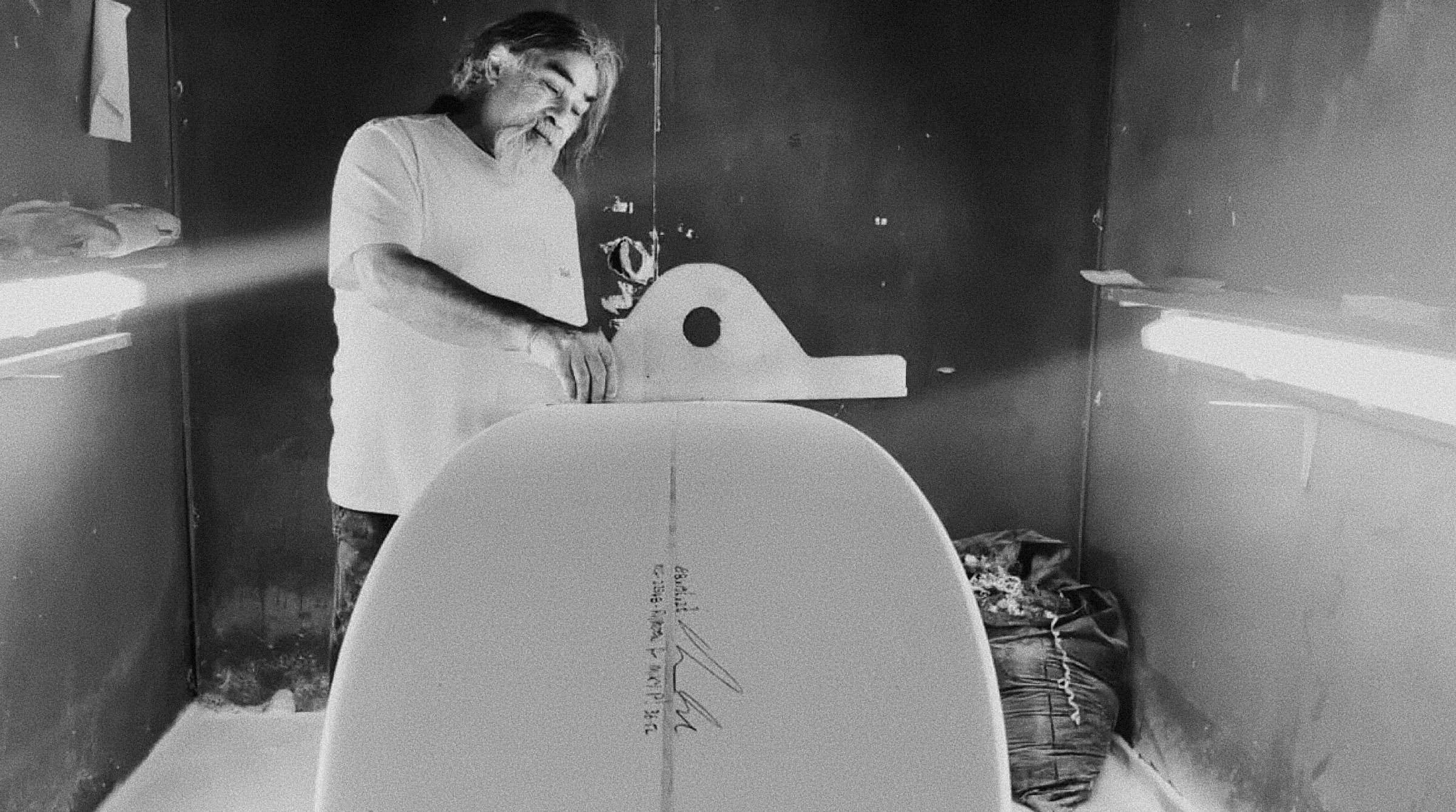
Cole is seventy-two. He still shapes. Not because the industry demands it — the industry has largely moved on to CNC machines and stock models, shaping by algorithm instead of hand. He shapes because the conversation between shaper and surfer cannot be automated. The CNC machine can cut a shape from a file. It cannot sit with a surfer for two hours, listening to how their back knee tracks in a cutback, watching video of their bottom turns, feeling the concave of their current board and understanding where the speed dies and why. That diagnosis is human. That response is craft.
The surf industry tells you the brand matters. That the team rider proves the product. That the three-letter logo on the deck is a guarantee of quality.
Cole is the counter-argument. The brand is a sticker. The shaper is the board. The difference between a surfboard and a Maurice Cole surfboard is the same difference between a house and an architecture — one is shelter, the other is a built response to how a specific person lives.
Every craft has its forgotten artists. The session musician who played the riff you have been humming for thirty years but whose name you never learned. The engineer who placed the microphone that captured the sound you associate with an entire era of music. The printer who pulled the darkroom print that you think of as “the photograph” but is actually one person’s interpretation of another person’s negative.
Maurice Cole is surfing’s version of that invisible mastery. The work is under your feet. The name is on the stringer. The craft is in every millimetre.
That is more than a shaper. That is an artist who chose a medium the world does not take seriously — and took it more seriously than anyone.
More from this domain
20 Aug 2026
OceanThe Wave That Never Reads You Back
A soliton is a wave engineered to never change. That is the point of Surf Ranch — and the exact reason it can teach a turn but never teach the ocean.
14 Jul 2026
OceanReading the Swell Before It Arrives
I check the 5am forecast half-asleep — and the math behind it was written in 1947 to put landing craft on a beach under fire.
26 Jun 2026
OceanThe Fin Setup Nobody Owns
Every board at Ribeira d'Ilhas ran three fins this morning. Mine too. Simon Anderson drew that setup in 1980 and never owned a cent of it.