
The Most Common Places Can Be Special
Same cliff path. Same rocks. Same ocean. Today the frame resolved differently. Beauty is not in exotic locations. It is in seeing what is already there.
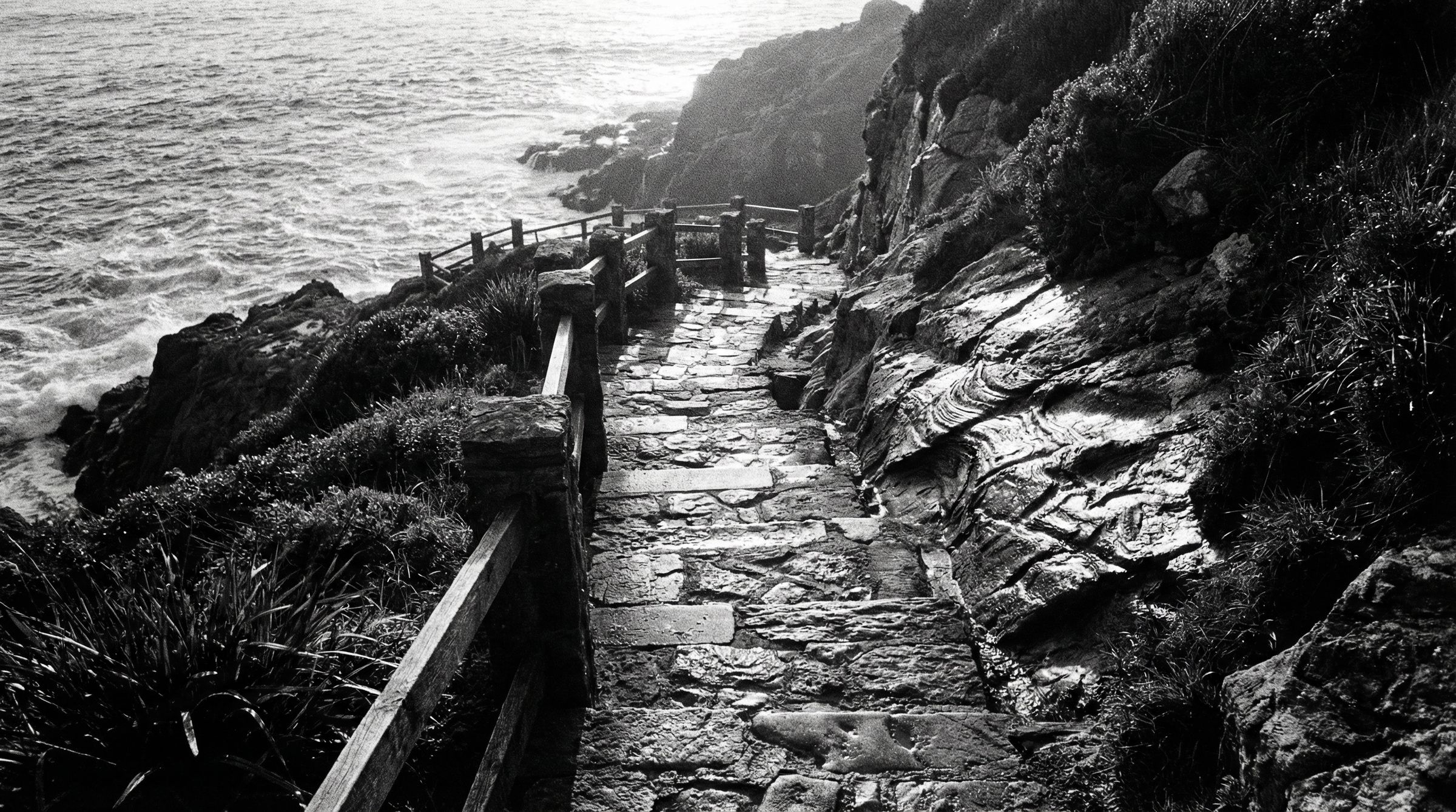
The cliff path north of Ribeira d’Ilhas. I have walked it a thousand times. Maybe more — I stopped counting years ago. The basalt is the same basalt. The Atlantic is the same Atlantic. The gorse bushes cling to the same ledges in the same wind. Nothing has changed.
Except the light.
Late afternoon, February, the sun sitting low enough that the shadows stretch long across the wet stone where a wave retreated twenty seconds ago. The rock surface holds a thin film of water — maybe two millimetres — and the low sun turns that film into a mirror. Not a reflection of the sky. A reflection of the cliff edge above, inverted, compressed into a strip of dark geometry on bright stone. I have never seen this. Not in a thousand walks. Not once.
I shoot it at f/4, 1/250s, Acros film simulation. The 35mm on the X-E5 gives me the 50mm-equivalent field of view — close enough to isolate the pattern, wide enough to hold the context of the rock shelf around it. The frame is simple. Wet stone, shadow, reflected edge, the ocean blurred to texture in the background. Monochrome strips the colour and leaves the structure. The image works because the geometry works, not because the location is dramatic.
This is the thing most photographers get wrong. They chase the exotic. The Icelandic waterfall. The Patagonian peak. The Moroccan souk at golden hour. As if beauty were a function of distance from home. As if the frame improves with the price of the plane ticket.
Peter Lindbergh shot on the same beaches in Deauville for decades. The sand, the overcast Norman light, the wind pulling at hair and fabric — the same elements, over and over, and every session produced something different because Lindbergh brought attention, not expectation. He was not waiting for the location to perform. He was watching until the location revealed what it had always contained.
Giorgio Morandi painted the same bottles and vases for forty years. The same objects, the same studio in Bologna, the same palette of muted ochres and greys. He did not travel. He did not seek novelty. He looked at what was in front of him until the looking itself became the art. Each painting is different because his attention was different — not the subject.
The common place becomes special when you stop expecting it to impress you and start watching what it actually does. The cliff path does not owe me a photograph. The light does not perform on command. My job is to be present with the camera and sharp enough to see when the ordinary rearranges itself into something that matters.
I walked back to the car with four frames. One of them is the best photograph I have taken this month. It is a picture of wet rock.
The camera is not a tool for recording exotic places. The camera is a practice in noticing. The discipline is not composition or exposure or focal length — those are mechanics. The discipline is showing up to the same place, with the same lens, and seeing it again for the first time.
The most common places can be special. But only if you are.
More from this domain
25 Aug 2026
PhotographyThe Case for Printing
The screen is a proof. The print is the photograph. An image that only ever lived on glass is unfinished work — a mix you never bounced.
24 Jul 2026
PhotographyHow to Read Light
Reading light is a trained skill, not luck. You see the finished frame before you raise the camera — the same way you read a set before it stands up.
16 Jun 2026
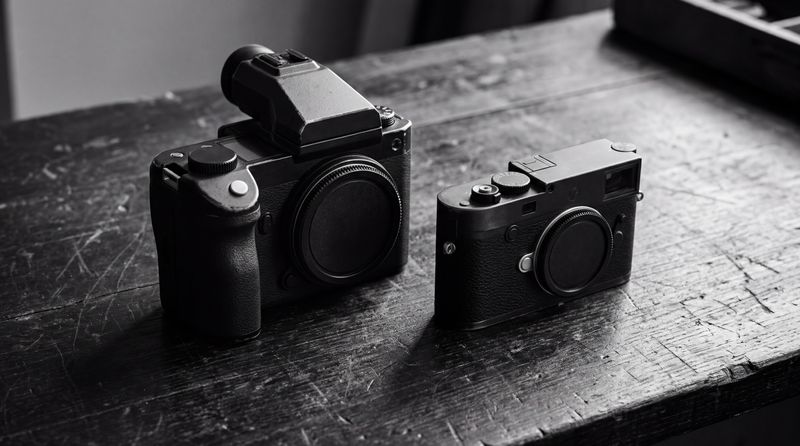
PhotographyThe GFX Question
The GFX 100S is not a better X-E5. It is a different instrument, and I keep the X-E5 anyway.