
JTM45, Plexi, 2203 JMP — You Need Them All
Three Marshall amps. Three eras. Three voices. You don't own three because you can't decide. You own three because each conversation is different.
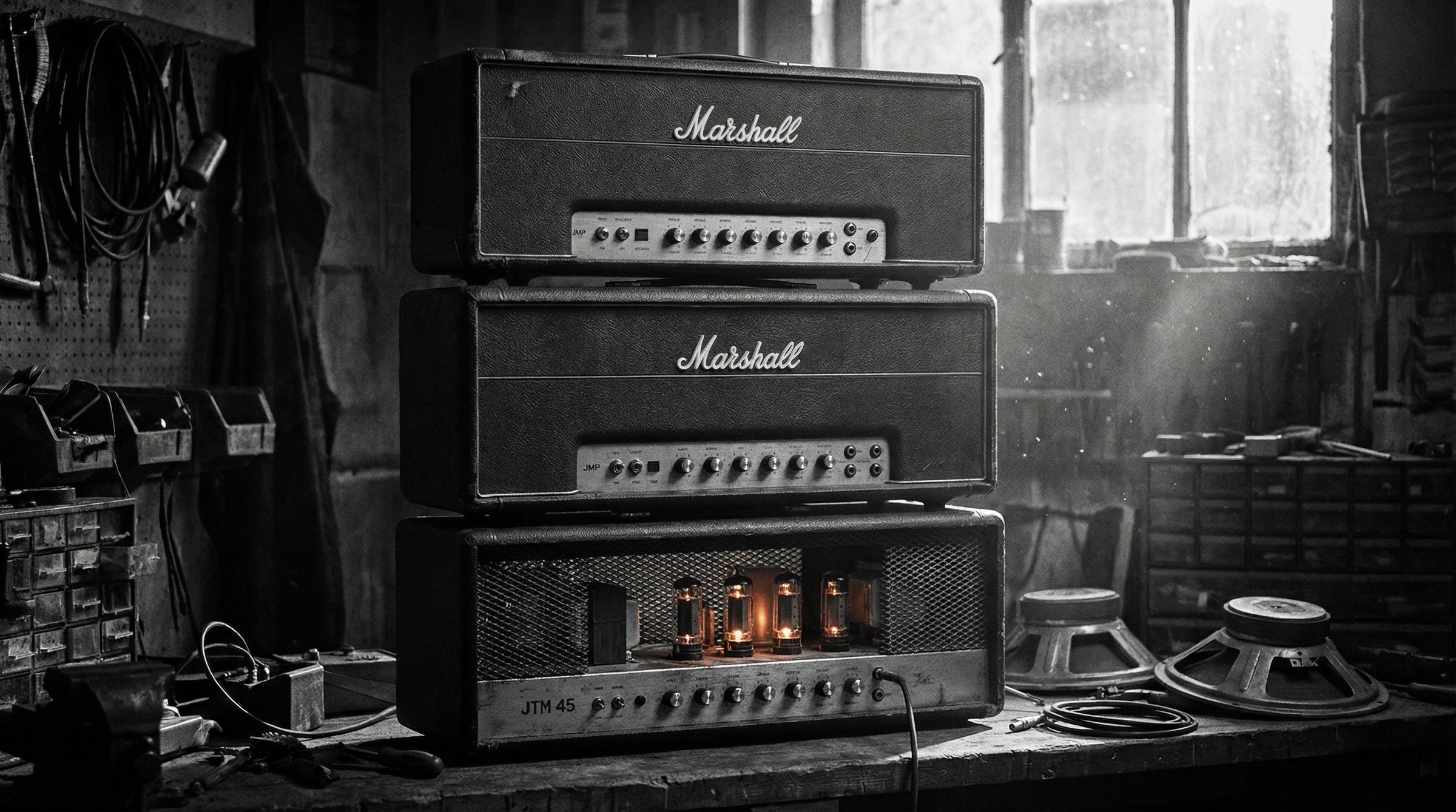
People ask me which Marshall they should buy. The question is wrong. That is like asking which surfboard you need. The answer is all of them — or more precisely, the right one for the wave you are riding today.
I own three Marshalls. A JTM45. A 1959 Super Lead Plexi. A 2203 JMP. They share a name on the headstock and almost nothing else. Three circuits, three decades, three entirely different philosophies about what happens when a guitar signal hits a power section.
The JTM45: 1962
Jim Marshall’s first amplifier is a modified Fender Bassman. Four inputs, two channels, no master volume, and a circuit topology borrowed from American tweed-era design but built with British components — Radiospares transformers, Mullard valves, and depending on the production run, either KT66 or EL34 power tubes.
That last detail matters more than most players realise. The KT66 runs are warmer, fatter, more compressed — a rounder breakup that sits in the low mids and blooms rather than bites. The EL34 runs are tighter, more aggressive, with a midrange push that cuts through a band mix like a blade through sailcloth. Two schools of Marshall tone were born from a supply chain decision. Not engineering intent. Component availability.
The JTM45 is the Bluesbreaker tone. Eric Clapton plugged a Les Paul Standard into one of these for the 1966 sessions with John Mayall — the Beano album — and the sound that came out redefined what an electric guitar could say. Thick, vocal, sustaining, with a breakup that responded to pick dynamics the way a good wave responds to weight shifts on the rail. Dig in and it growls. Back off and it cleans up. The amp breathes.
I play the JTM45 when the music calls for conversation, not declaration. Low-volume sessions. Recording where the microphone is close and the room is small. Blues phrasing where every note needs space around it. The JTM45 is a 35mm lens — intimate, honest, nowhere to hide.
The 1959 Super Lead Plexi: 1965
The Plexi is not an amplifier. The Plexi is a weather event.
100 watts through four EL34s, no master volume, into a 4x12 cabinet loaded with Celestion G12M Greenbacks or — if you are chasing the Page tone — G12H30s for the extra low-end authority. The “Plexi” name comes from the Plexiglas panel on the front. The sound comes from turning all four inputs up past seven and letting the power section do what 100 watts of non-master-volume fury does when it runs out of headroom.
Hendrix at Monterey. Page at Madison Square Garden. Townshend destroying them at Leeds. The Plexi defined what “loud” meant for a generation of rock and roll. But volume is not the point — or rather, volume is the mechanism, not the goal. The Plexi sounds the way it sounds because the power tubes are being pushed into saturation, the output transformer is compressing the signal, and the speakers are moving enough air that the cabinet itself becomes part of the instrument. The tone does not happen at polite volumes. The tone happens at the point where the room starts to fight back.
I play the Plexi when the music is a wall. When the riff needs mass, not articulation. When the band is loud and the guitar has to occupy physical space, not just frequency range. The Plexi is a 6’2” gun — built for size, committed to power, useless in small conditions.
Playing a Plexi in a bedroom is like riding a big-wave board in two-foot mush. The equipment is designed for a specific dynamic range. Below that range, it is just heavy.
The 2203 JMP: 1975
The 2203 solved the Plexi’s fundamental problem: you had to be deafeningly loud to get the tone. The solution was a master volume — a second gain stage that let you drive the preamp tubes into distortion while keeping the output volume manageable. Preamp gain became independent of power section volume. For the first time, you could get Marshall distortion without Marshall volume.
The circuit is straightforward. One channel, three ECC83 (12AX7) preamp tubes cascaded for gain, a presence control, a master volume, and the same EL34 power section as the Plexi but now operating cleaner because the distortion is happening earlier in the chain. The sound is tighter, more focused, with a scooped midrange that sits differently in a band mix than the Plexi’s midrange push.
This is the amp that built arena rock. Angus Young used variants of this circuit from the late 70s onward. Slash tracked the Appetite for Destruction rhythm tones through a modified 2203. Randy Rhoads. Zakk Wylde. The 2203 and its direct descendant, the JCM800 2203, gave every guitarist from 1975 to 1990 a platform that delivered Marshall distortion at volumes a sound engineer could actually manage on stage.
I play the 2203 when the music needs controlled aggression. High-gain rhythm work. Tight palm mutes. The kind of playing where every note has to start and stop on command, where the distortion needs to be a tool, not a force of nature. The 2203 is a thruster — responsive, precise, designed for performance across a wide range of conditions.
The Quiver
Surfers understand this instinctively. You do not own a quiver of boards because you cannot pick a favourite. You own a quiver because the ocean presents different conditions and each board speaks a different language.
A 5’10” performance shortboard for punchy beach breaks. A 6’2” step-up for overhead reef. A 7’6” mid-length for small, clean days when speed matters more than turns. Three boards. Three conversations with the wave.
The same logic applies to lenses. A 35mm for environmental context. A 50mm for honest perspective. An 85mm for compression and isolation. No photographer owns three primes because they cannot choose. They own three because each focal length sees differently.
The JTM45 is my blues lens. The Plexi is my big-wave gun. The 2203 is my daily driver. Each one does something the others cannot. Not better. Different. The vocabulary changes. The syntax changes. The things I say with a guitar in my hands change depending on which amplifier is receiving the signal.
People who chase “the one amp that does everything” are chasing a compromise. A do-everything amp does everything adequately and nothing with character. Character comes from commitment to a specific voice — the warmth the JTM45 gives up in exchange for its bloom, the volume the Plexi demands in exchange for its saturation, the rawness the 2203 sacrifices for its control.
Three amps. Three eras. Three conversations. You need them all.
More from this domain
4 Sept 2026
MusicPAF: The Pickup That Should Not Exist
Gibson printed the wrong patent number on its own legendary pickup for years. The PAF fails every modern QC test — and that failure is the tone.
3 Aug 2026
MusicThe Accidental Circuit
The Neve 1073 is the most worshipped preamp in recording, and the sound everyone chases is a defect its own designer set out to engineer away.
1 Jul 2026
MusicThe Floor Under House Music
The TR-909 and TB-303 were flops. That is the reason house exists — I can trace the whole genre to a supply chain of failed gear.