
Peter, Ellen, Claudia, Cindy, Linda
The supermodel era was the last time fashion photography had a point of view. Lindbergh showed the person. Von Unwerth brought rebellion.
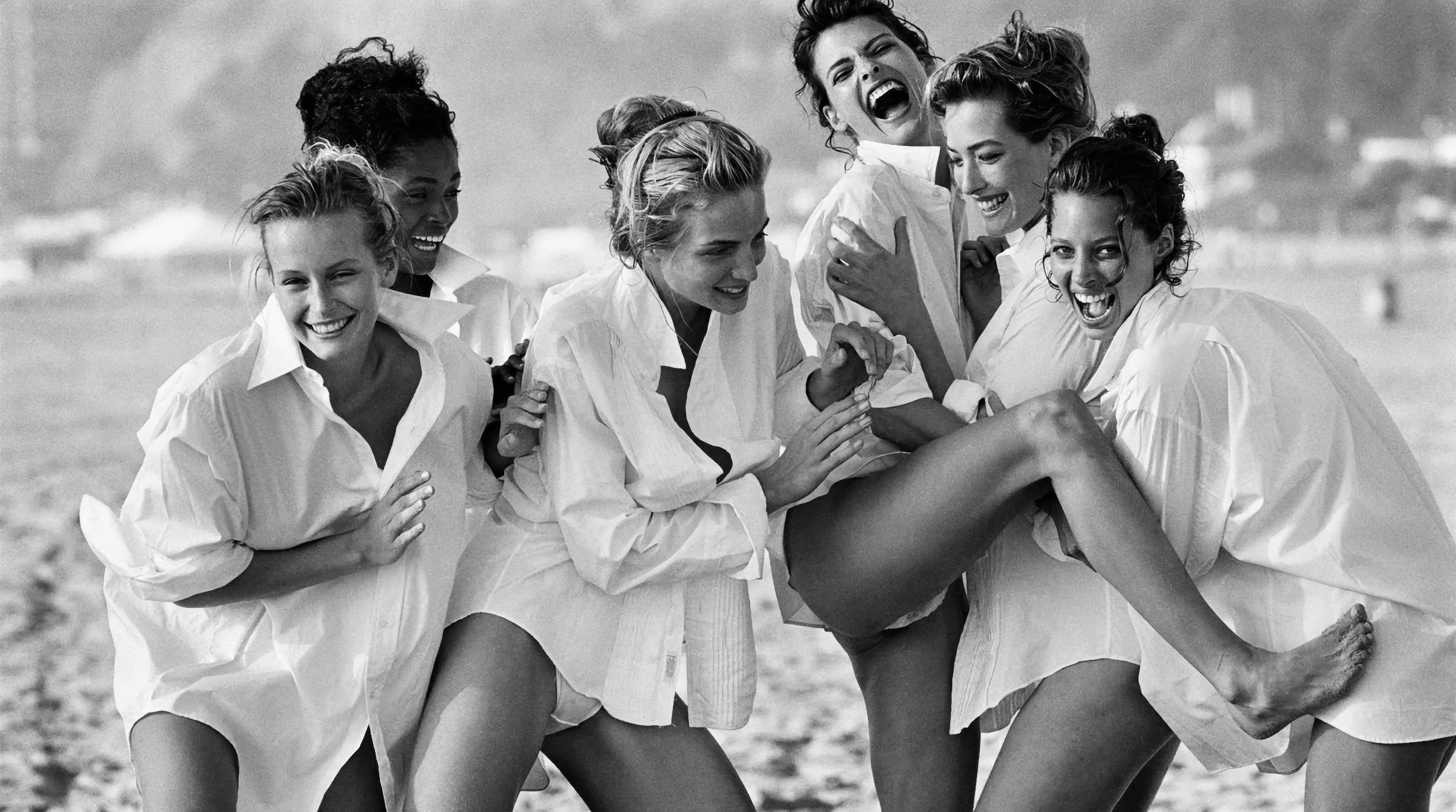
Peter Lindbergh shot five women on a beach in Santa Monica in January 1990. White shirts. No makeup — or close enough to none that it mattered. Natural light. Black and white Tri-X, probably pushed a stop. The photo ran as the cover of British Vogue. Naomi Campbell, Linda Evangelista, Tatjana Patitz, Christy Turlington, Cindy Crawford. Five women standing on sand, looking straight at the camera with the kind of authority that can only come from knowing you do not need the photographer more than the photographer needs you.
That image is credited with launching the supermodel era. The claim is debatable — models had been famous before, editorial photography had been powerful before. But something shifted with that cover. The models stopped being anonymous bodies wearing the clothes. They became the point. They had names. They had voices. They had the leverage to say no to photographers, to demand creative control, to choose which magazines they would work with and which they would not.
The industry has been trying to undo that power ever since.
Lindbergh: The Person, Not the Brand
Peter Lindbergh’s career position was simple and he stated it without hedge: beauty is truth. Not beauty is perfection. Not beauty is youth. Truth. He refused to retouch. This was not a marketing stance — it was a technical and philosophical commitment that cost him jobs and defined his legacy.
The 1988 Vogue Italia cover — Michaela Bercu, shot in Israel, available light, no retouching — was the first major fashion cover that showed skin texture, pores, the physical reality of a human face under natural illumination. Anna Wintour had just taken over American Vogue. She saw Lindbergh’s work and brought him in. The partnership changed fashion photography for a decade.
Lindbergh’s method was simple and ruthlessly consistent. One camera — typically a Mamiya RZ67 for editorial, occasionally 35mm for movement. Black and white film. Available light or, when he used artificial light, a single large source positioned to imitate a window. No coloured gels. No complex multi-light setups. No wind machines unless the image specifically demanded one, and even then, reluctantly.
The consistency meant the work was about the subject, never the technique. The same way Angus Young’s signal chain — Gibson SG, cable, Marshall — means the audience hears the player and nothing else. Lindbergh stripped the process until only the person remained. His portraits of Claudia Schiffer are the clearest example. The fashion industry was selling Schiffer as a blonde fantasy — the Bardot comparison, the guess campaigns, the glamour. Lindbergh photographed her in Berlin, her hometown, against concrete walls, in winter light, in a heavy coat with no stylist involvement. The photographs show a woman — intelligent, present, slightly guarded — not a brand.
His monograph Images of Women is the best single book on fashion portrait photography published in the last thirty years. Not because of the technical instruction it contains (it contains almost none). Because every image demonstrates a position: the subject’s humanity is more interesting than the photographer’s craft. That is a position most photographers claim to hold and almost none actually practice.
Von Unwerth: Rebellion With Craft
Ellen von Unwerth arrived from the other direction entirely. Where Lindbergh was austere — black and white, minimal production, a kind of German severity that served the subject through restraint — von Unwerth was kinetic, playful, explosively feminine. And she was at least as technically skilled.
Von Unwerth had been a model herself for ten years before she picked up a camera. This matters. She understood the power dynamic from both sides of the lens. Her work with Claudia Schiffer in the early Guess campaigns — the black and white series that turned Schiffer from an unknown German girl into the most recognisable face in fashion — succeeded because von Unwerth directed from a position of complicity, not authority. She was not telling the model what to be. She was inviting the model to play.
The images from those Guess shoots are still the best examples of the feminine gaze in commercial photography. The models are sexual without being objectified — a distinction that sounds like semantics until you see the work next to its male-gaze equivalent. Richard Avedon’s nudes are studies in form. Helmut Newton’s nudes are provocations designed to make the viewer uncomfortable. Von Unwerth’s nudes — and her clothed work, which carries the same energy — are celebrations. The woman in the frame is having a good time. She is not performing for the camera. She is using the camera to amplify something that was already happening.
Von Unwerth’s monograph Couples is the photographic equivalent of AC/DC’s Back in Black. Simple. Direct. Executed with a craft so precise that the apparent simplicity becomes its own kind of sophistication. Every image looks effortless. None of them were.
The technical craft behind von Unwerth’s work is consistently underrated — probably because the images look so spontaneous. Her lighting is immaculate. Natural light supplemented with small reflectors, occasionally a ring flash for that 60s-pop direct-light feel, but always motivated by the scene rather than imposed on it. Her compositions are loose but never careless — the negative space, the body positioning, the relationship between the subject and the environment all serve the narrative. She shoots fast, on instinct, but the instinct is trained by thirty years behind a camera and ten years in front of one.
The Supermodels Were Not Mannequins
The critical difference between the supermodel era and everything that came after is agency. Campbell, Crawford, Evangelista, Schiffer, Patitz, Turlington — they were not interchangeable. Each brought a specific energy that photographers learned to work with, not override.
Linda Evangelista could transform. She famously said she did not wake up for less than $10,000 a day — a line that got quoted as diva behaviour and was actually a precise statement of market value from someone who understood the economics of her industry better than most of its executives. Evangelista changed her hair for every major editorial. The blond crop for the Versace campaigns. The dark bob for the Dolce & Gabbana era. Each change was a creative decision, made in collaboration with photographers and stylists, that redefined what the industry considered beautiful for six months at a time.
Cindy Crawford had the commercial instinct. The Pepsi campaign. The Revlon contract. The MTV House of Style. Crawford understood that fashion could be accessible without being cheap, that a supermodel could be on the cover of Playboy and Vogue in the same year and both covers would be honest — because Crawford was not pretending to be something different for each audience. She was the same person, adjusting the register. Same as playing the same Les Paul through a clean channel and an overdrive channel. Different tone, same instrument, same player.
Claudia Schiffer carried the European editorial tradition — Chanel, Valentino, the high fashion houses that demanded a model who could stand still in a couture gown and project authority through posture alone. Her work with Karl Lagerfeld at Chanel is a masterclass in fashion photography as architecture. The clothes, the model, the set, the light — everything structured, every element placed, and Schiffer anchoring the frame with a stillness that most models could not sustain for more than two or three frames. She could sustain it for an entire roll.
Naomi Campbell brought intensity. Her editorial work with Herb Ritts — the black and white series shot in Death Valley, natural light, the body as landscape — remains some of the most powerful fashion photography ever committed to film. Ritts used California light the way a surf photographer uses golden hour: patiently, knowing the window is narrow, knowing the light does all the heavy lifting if you position yourself correctly and do not interfere. Campbell’s physicality in those images is athletic, sculptural, almost confrontational. She does not invite the viewer in. She holds the space.
What We Lost
The supermodel era ended — gradually, then suddenly — when the economics shifted. Magazines cut rates. Photographers lost editorial independence as advertisers gained creative control. The models who replaced the supermodels were younger, cheaper, and deliberately anonymous. The industry did not want personality. Personality has leverage. Personality says no. Anonymous faces say yes to everything and charge less.
Digital photography accelerated the collapse. Film forced discipline — 36 frames per roll, every shot costs money, you and the subject build the image together through a process that demands patience and trust. Digital removed the constraint. Shoot 3,000 frames, pick the best one in post, retouch everything, ship. The photographer’s role shifted from creator to capture device. The retoucher became the most important person in the chain.
Today’s fashion photography has technique. It has resolution. It has skin smoothing algorithms that can remove every pore from a 100-megapixel image. What it does not have is a point of view.
A point of view is expensive. It requires a photographer who will refuse to retouch. A model who will demand creative input. A magazine editor who will choose an image because it is honest, not because it is safe. Every one of those choices costs something — a client, a booking, a cover. Lindbergh paid that cost for forty years. Von Unwerth pays it still.
Personal
This is not art criticism. This is confession.
I shoot black and white because of Lindbergh. I shoot with a 50mm (35mm on APS-C, same field of view) because Lindbergh’s focal length discipline taught me that constraint is not limitation — it is vocabulary. I look for available light because Lindbergh proved that artificial light, in most contexts, is a lie. The photograph should show what was there, not what was constructed.
Von Unwerth taught me that seriousness is not the only path to craft. That playfulness and technical precision are not in tension. That the best images happen when the person behind the camera and the person in front of it are collaborators, not adversaries.
The supermodels taught me that the subject is never passive. The person in the frame has a voice. If the photographer does not hear it, the image is a projection, not a portrait.
Lindbergh died in 2019. His last published work, Untold Stories, was exhibited in Dusseldorf — black and white portraits, unretouched, the same commitment he held from the first Vogue cover to the last frame. The industry eulogised him as a visionary. Then it went back to retouching everything.
The gap between what people say they value and what they actually ship is where most promises go to die. In fashion photography, that gap is now the entire industry.
Five women on a beach. White shirts. No retouching. That was the point of view. We have not replaced it. We have only filtered it out.
More from this domain
25 Aug 2026
PhotographyThe Case for Printing
The screen is a proof. The print is the photograph. An image that only ever lived on glass is unfinished work — a mix you never bounced.
24 Jul 2026
PhotographyHow to Read Light
Reading light is a trained skill, not luck. You see the finished frame before you raise the camera — the same way you read a set before it stands up.
16 Jun 2026
PhotographyThe GFX Question
The GFX 100S is not a better X-E5. It is a different instrument, and I keep the X-E5 anyway.