
Gary Moore Could Make a Guitar Cry
From Thin Lizzy's aggression to Parisienne Walkways' sustain. The fast players get attention. The slow players get remembered. Patience is the technique.
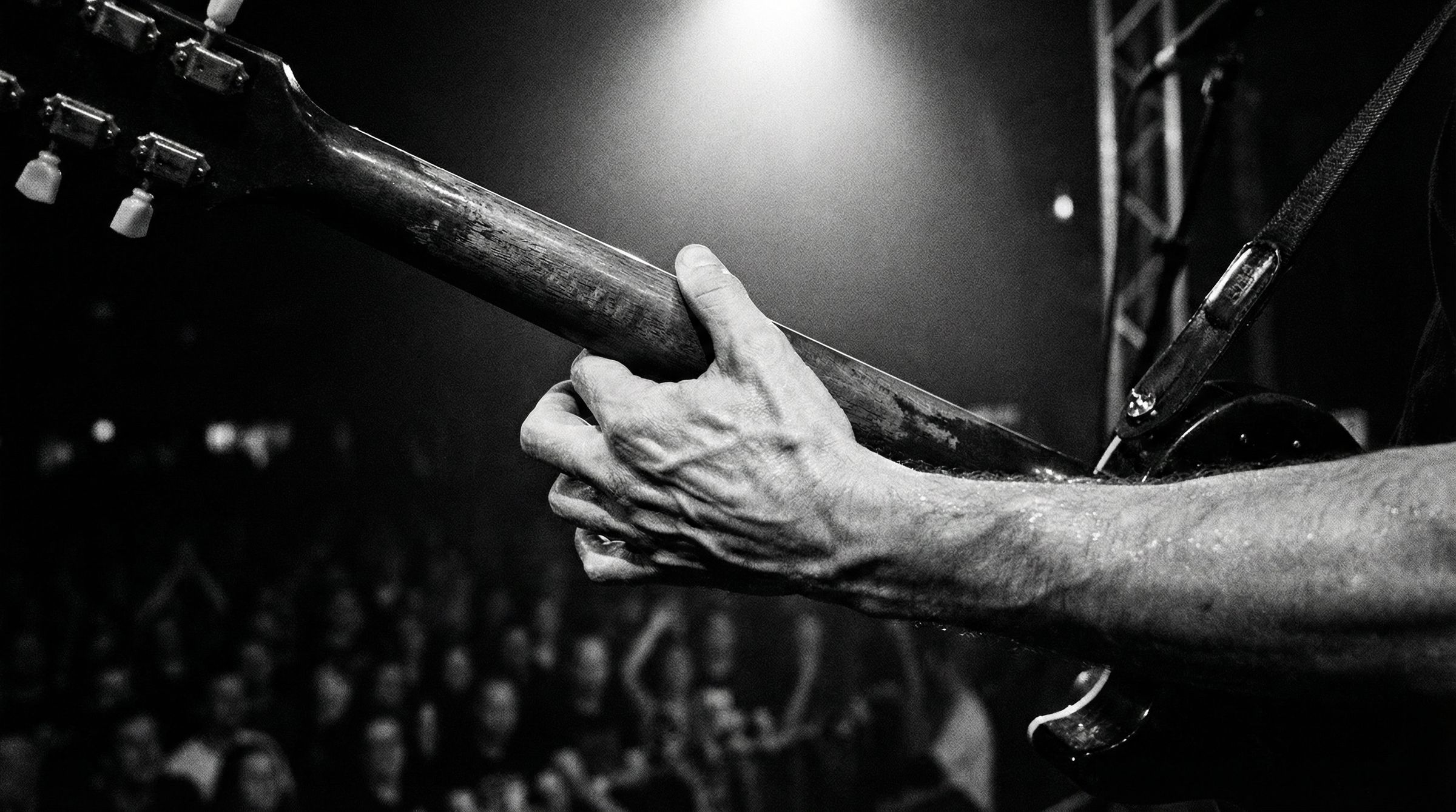
Gary Moore played a Les Paul Standard through a cranked Marshall 1959SLP Plexi and made grown men cry. Not with speed — he had speed, absurd speed, the kind of speed that made him one of the most technically gifted players in the history of the instrument. But speed was not what he chose. He chose sustain. He chose vibrato. He chose one note, held at the edge of feedback, bent a quarter tone sharp and then released with a vibrato so wide and so controlled that the note breathed like a human voice.
That choice is the hardest thing in any discipline.
The Thin Lizzy Years
Moore joined Thin Lizzy in 1978, replacing Brian Robertson. The band was running on adrenaline and whiskey and Phil Lynott’s bass lines, and Moore’s job was simple: fill the room with fire. He did. The live recordings from that period — “Don’t Believe a Word” at the Hammersmith Odeon, “Black Rose” from the German tours — are studies in controlled aggression. Moore’s tone was a wall. The Les Paul’s mahogany body drove low-mids into the Marshall’s power stage until the speakers physically pushed air. You could feel his rhythm parts in your chest before you heard the notes.
The lead work from this era was fast. Legitimately fast. Alternate-picked runs at tempos that most guitarists today would tap or sweep to avoid the difficulty. But Moore picked every note. No shortcuts. No economy of motion tricks. Brute force through a plectrum and four fingers on a neck built for baseball players, not speedrunners. The Les Paul’s thick 50s-profile neck fought him on every rapid passage. He did not care.
He was twenty-six years old and he was one of the fastest players alive. And then he did something almost nobody in rock music has ever done.
He slowed down.
Parisienne Walkways
The recorded version of “Parisienne Walkways” — the studio cut with Phil Lynott’s vocal — is three minutes and forty-eight seconds. Moore’s solo starts at around 1:40. The first note is a bend on the B string, 15th fret, Les Paul neck pickup, Marshall just at the edge of breakup. One note. Bent slowly, deliberately, with vibrato that widens as the note sustains.
The entire solo is built this way. Bends. Vibrato. Sustained notes that ring into feedback and then resolve into the next phrase. The fastest passage in the solo is a brief, almost reluctant flourish that lasts maybe two seconds before Moore pulls back into another held note. He had the technique to fill every bar with sixty-fourth notes. He filled them with space instead.
The live versions are even more extreme. The 1984 Emerald Aisles performance stretches the solo to over five minutes. Moore stands there — Les Paul hanging from the strap, barely moving, eyes closed — and lets each note decay fully before playing the next. The audience is silent. Not because they are bored. Because the guitar is doing something that human voices do: it is expressing grief, and grief does not rush.
The tone is everything. The Les Paul’s PAF-style humbuckers — high impedance, Alnico magnets, a resonant peak that sits in the vocal midrange around 2-3 kHz — sustain into the Marshall’s power tubes until the note becomes self-reinforcing. The guitar feeds back at exactly the pitch Moore intends because he controls his position relative to the amp cabinet with the precision of an inch. Step forward: more feedback, higher sustain. Step back: the note begins to decay. His body is a volume control. His vibrato is a human tremolo. The instrument and the amplifier and the player are a single feedback system, and Moore is manipulating all three simultaneously while appearing to do nothing at all.
That is mastery. Not the speed. The control.
The Discipline of Slow
Gilmour does the same thing on “Comfortably Numb.” Four bends in the first solo. Each one placed with surgical precision, each one arriving at a pitch that no written notation could capture because the expression lives between the frets — a quarter tone here, a vibrato that lands just above the target note there. The technique is not bending. Bending is mechanics. The technique is patience. Knowing when to play and — this is the part most players never learn — knowing when to not.
Lindbergh understood the same principle with a camera. The fashion industry in the late 80s was all movement, all production, all spectacle. Lindbergh put Cindy Crawford against a white wall in available light and shot one roll of black and white Tri-X. No wind machines. No wardrobe changes. No crew of forty. The result was the most honest, most compelling fashion photography of the decade — because Lindbergh had the technique to do everything and chose to do almost nothing.
In surfing, the same discipline separates good from great. The intermediate surfer throws spray on every section — top turn, cutback, snap, because the wave allows it and the surfer can. The advanced surfer holds the line. Reads the wave two sections ahead. Chooses one turn — the right turn, at the right moment, with the full speed and compression of the board committed to a single arc — and lets the rest of the wave breathe.
Moore knew the wave was asking for a single note. He gave it one.
What Speed Costs
The fast players get attention. Yngwie Malmsteen, Shawn Lane, Paul Gilbert — they fill arenas and YouTube compilations and they deserve the technical admiration. Every one of them has worked harder than most people will ever work at anything. Speed is real. Speed is earned.
But speed fills the air. Sustain fills the listener.
Moore’s vibrato on the final note of Parisienne Walkways — live, any version, pick one — teaches more about guitar playing than any shred tutorial on the internet. That vibrato says: I chose this note. I committed to this note. I will let this note exist in the room for as long as it needs to, and I will not replace it with another note just because I can.
Patience is not the absence of technique. Patience IS the technique.
Moore died in 2011 in a hotel room in Estepona, Spain. He was fifty-eight. The Les Paul and the Marshall survived him. The notes, somehow, are still sustaining.
More from this domain
4 Sept 2026
MusicPAF: The Pickup That Should Not Exist
Gibson printed the wrong patent number on its own legendary pickup for years. The PAF fails every modern QC test — and that failure is the tone.
3 Aug 2026
MusicThe Accidental Circuit
The Neve 1073 is the most worshipped preamp in recording, and the sound everyone chases is a defect its own designer set out to engineer away.
1 Jul 2026
MusicThe Floor Under House Music
The TR-909 and TB-303 were flops. That is the reason house exists — I can trace the whole genre to a supply chain of failed gear.