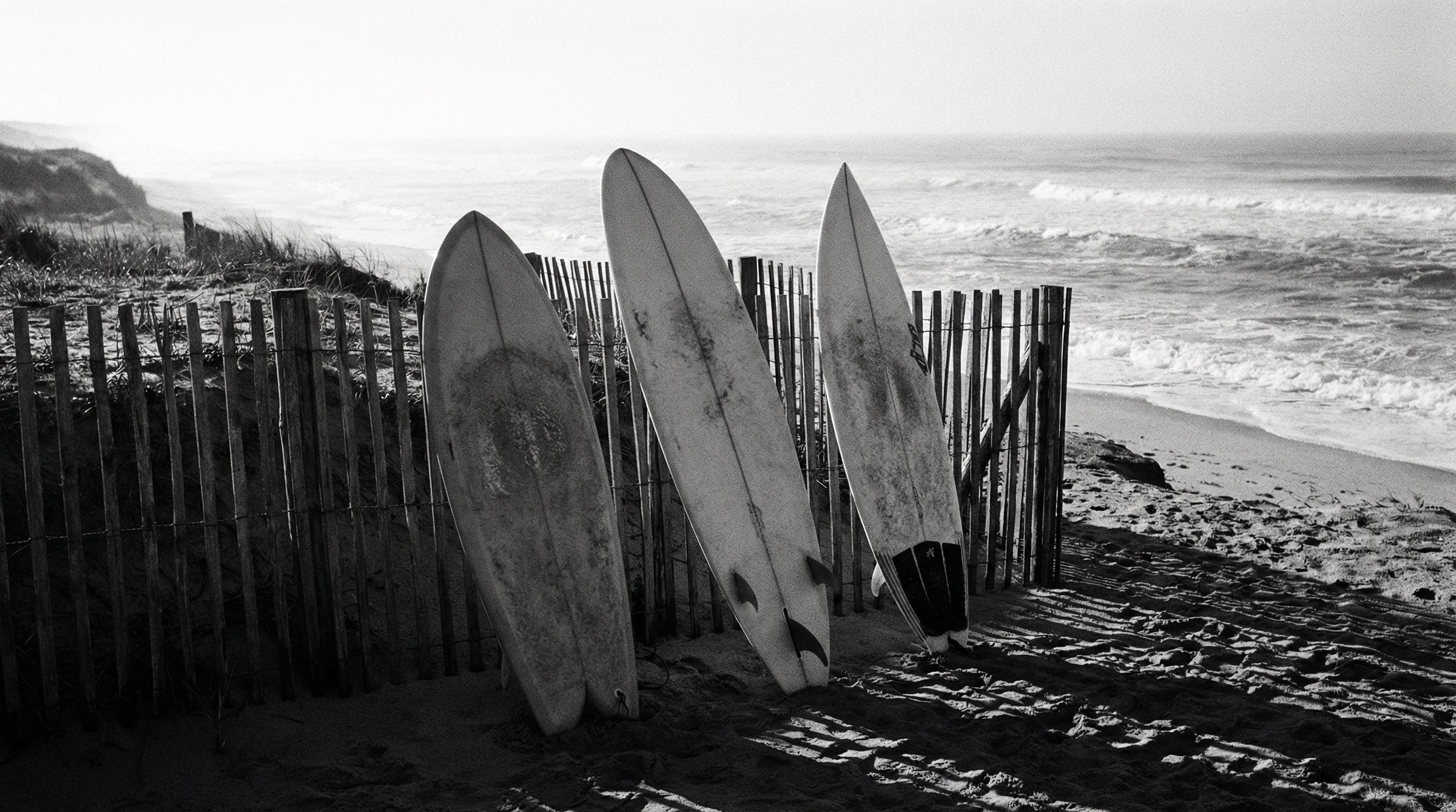
Fish Glide, Mid Length Fun, Shortboard Rips
Three boards, three conversations with the wave. The fish glides, the mid-length forgives, the shortboard rips. The quiver is vocabulary, not indulgence.
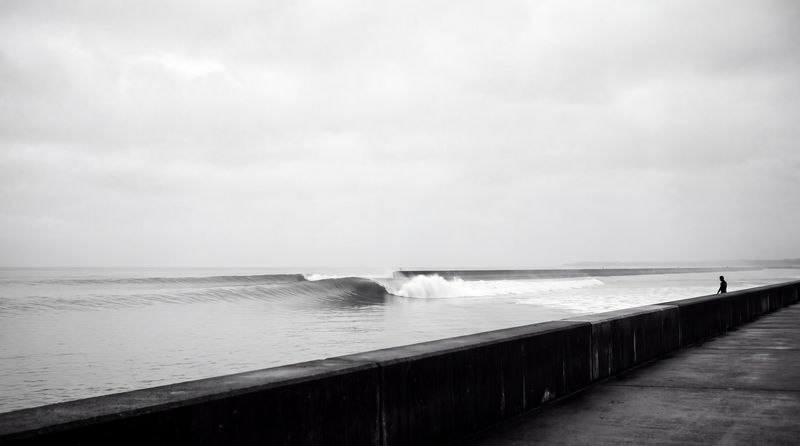
I surfed three boards in three days last week. Same break — Ribeira d’Ilhas, the right-hander that does not forgive lazy positioning. Same swell direction, SSW at 4-6 feet, 12-second period. Three completely different sessions. Three completely different conversations with the same wave.
The boards: a 5’8” twin-fin fish, 21” wide, 2 5/8” thick, flat rocker with a deep swallow tail. A 7’0” mid-length, 21 3/4” wide, 2 7/8” thick, single-to-double concave, 2+1 fin setup. And a 5’10” shortboard thruster, 18 3/4” wide, 2 3/8” thick, moderate-to-aggressive rocker, FCS II fins. The quiver sitting in my garage, waiting to be asked a different question.
The Fish Glides
Tuesday. Small, clean, waist-to-chest high. The kind of day that punishes shortboards and rewards volume. I took the fish.
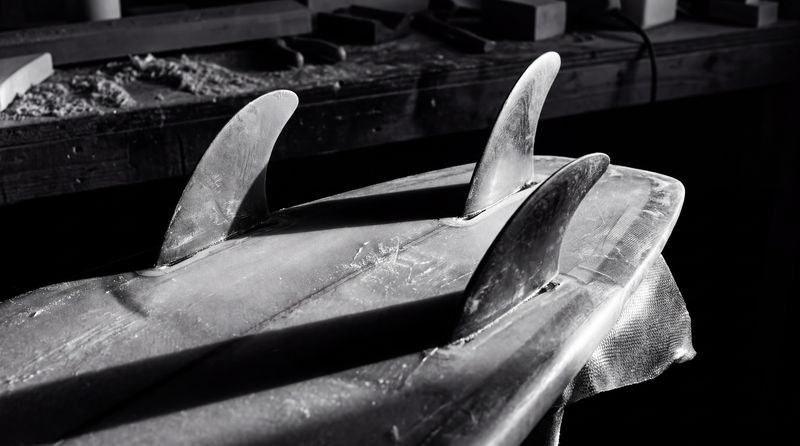
The twin-fin fish does one thing better than any other board on the planet: it generates speed from nothing. The wide tail, the flat rocker, the twin keel fins that release water instead of holding it — the board skims across flat sections where a shortboard would bog. The trim is effortless. You set the rail, you project down the line, and the board simply goes. No pumping. No forced turns to maintain momentum. The wave provides the energy and the fish converts every joule of it into forward motion.
The trade-off is control. Twin fins are loose. Beautifully, terrifyingly loose. The tail slides on steep faces. Turns are drawn from the hips, not carved from the rail — wide, sweeping arcs that feel more like skiing than surfing. You do not attack the lip on a fish. You flow with the wave’s contour, finding pockets of speed the way a jazz musician finds pockets of rhythm between the downbeats.
On a small, clean day, the fish is the best board in the water. Not close.
The Mid-Length Is Fun
Wednesday. Bigger, more inconsistent, mixed-period swell. The kind of day where half the lineup is out of position because they cannot paddle fast enough. I took the 7’0”.
The mid-length is the board that makes everyone smile. It paddles like a longboard — that extra volume, that length, you catch waves before the shortboarders even see them. You are first into the lineup, first into the wave, first into the trim. The forgiveness is almost unfair. Late takeoff on a steep section that would pitch you on the shortboard — the mid-length just holds, nose barely lifting, rail engaging with a gentle authority that says “I have this.”
I spent two hours gliding. Long, drawn-out bottom turns. Smooth cutbacks that arc through 180 degrees without losing speed. The occasional nose-forward trim that feels like standing on a moving sidewalk. Easy. Effortless. Fun in the most uncomplicated sense of the word.
The mid-length is the Telecaster of surfboards. Simple. Reliable. Does eighty percent of what you need with zero drama. And like the Telecaster, it will never give you the last twenty percent — the explosive top turns, the vertical re-entries, the speed-to-power transitions that separate riding waves from ripping them.
Fun is not a small thing. But fun is not the whole thing.
The Shortboard Rips
Thursday. Head-high, offshore, clean faces with lip. The wave was asking for aggression. I took the 5’10”.
The shortboard punishes you for the first twenty minutes. The paddle is slower — 26 litres versus 42 on the mid-length. You sit deeper in the water. You work harder to get into position. You miss waves that the mid-length would have caught three strokes earlier. Every session starts with a tax.
Then you catch one. And the tax disappears.
The bottom turn compresses. The rail bites, the rocker engages, and the board arcs under you with a precision that the fish and the mid-length cannot approach. You project off the bottom and the board goes vertical — actually vertical, fins releasing at the lip, body rotating through the spray, and for a fraction of a second the wave and the board and your body are a single system operating at the edge of what physics will allow.
That feeling. The shortboard gives you that feeling.
The thruster fin setup — three fins, two side bites and a centre — holds through turns that would wash out the twin-fin. The narrow tail, the aggressive rocker, the thin rails — every design choice is a sacrifice of comfort for responsiveness. The board does not help you. It responds to you. Every subtle weight shift translates into rail pressure. Every micro-adjustment in your back foot changes the arc. The shortboard is the closest you get to the wave’s pulse — no intermediary, no forgiveness, no buffer between your intent and the water’s response.
It is a 50mm prime lens. No zoom. No safety net. You see what is in front of you and you commit.
The Quiver Is Vocabulary
People look at three boards in a garage and see indulgence. I see vocabulary.
The fish is a clean tone on the neck pickup — warm, full, smooth. The mid-length is the rhythm guitar — steady, reliable, always in the pocket. The shortboard is the lead break — aggressive, precise, everything on the line.
Same as having a Les Paul and a Strat. The Les Paul sustains where the Strat cuts. The Strat chimess where the Les Paul growls. They are not interchangeable — they are complementary. You do not sell the Strat because the Les Paul is “better.” You pick the instrument that matches the song.
Same as shooting 35mm and 50mm. The 35mm gives you context, environment, the person in their world. The 50mm gives you the person, isolated, the background falling into blur at f/1.4. One is not superior. They see differently.
Three boards. Three focal lengths. Three pickup positions.
The surfer who rides one board speaks one language. Fluent, maybe. But limited. The quiver is not about having more gear. It is about range. And range is fluency.
The wave asks a question every single day. It helps to have more than one answer.
More from this domain
20 Aug 2026
OceanThe Wave That Never Reads You Back
A soliton is a wave engineered to never change. That is the point of Surf Ranch — and the exact reason it can teach a turn but never teach the ocean.
14 Jul 2026
OceanReading the Swell Before It Arrives
I check the 5am forecast half-asleep — and the math behind it was written in 1947 to put landing craft on a beach under fire.
26 Jun 2026
OceanThe Fin Setup Nobody Owns
Every board at Ribeira d'Ilhas ran three fins this morning. Mine too. Simon Anderson drew that setup in 1980 and never owned a cent of it.