
Why Comfortably Numb Is a Legend
The greatest guitar solo in rock history is not about speed or complexity. It is about patience. Gilmour waits. The notes breathe.
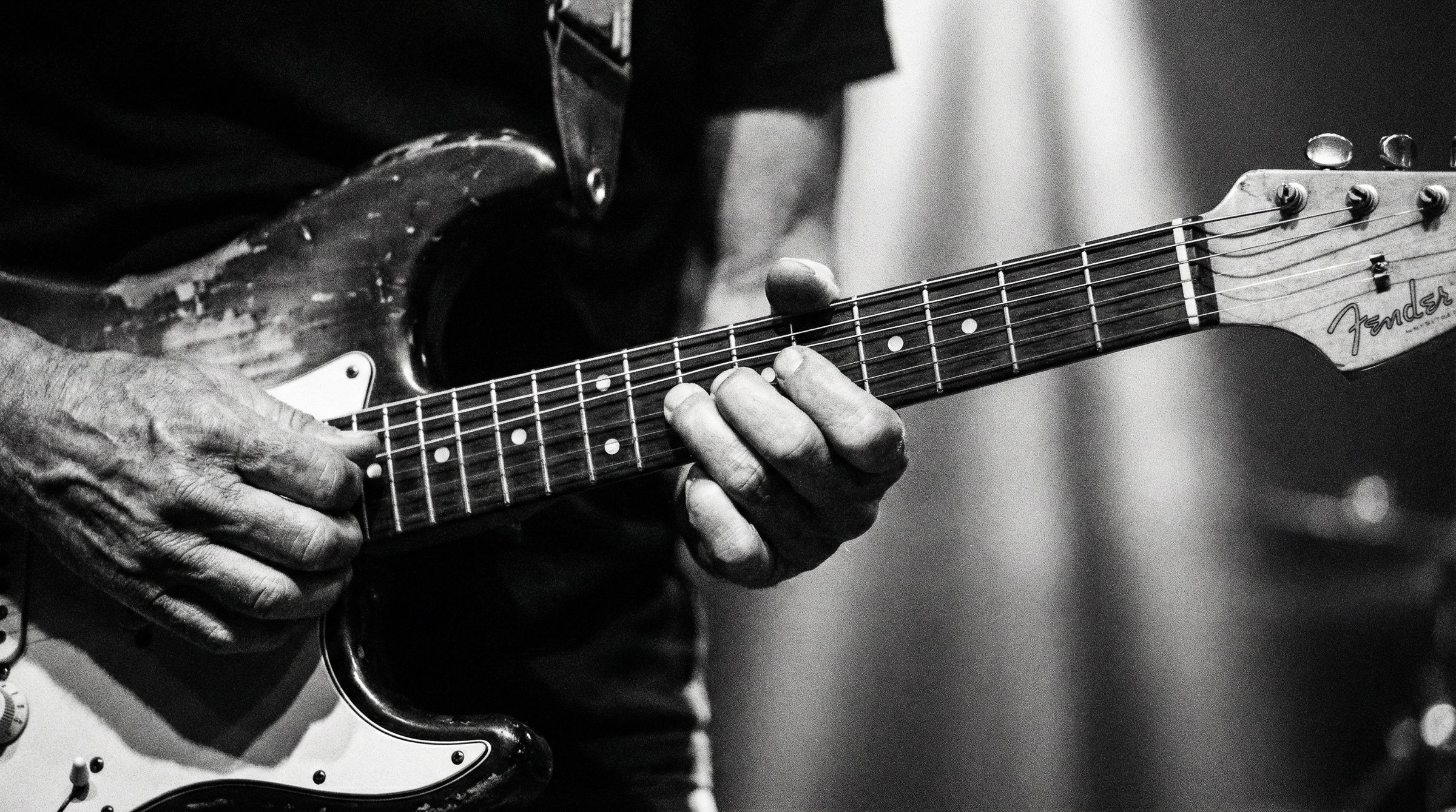
The second guitar solo in “Comfortably Numb” begins at the 4:31 mark with a single bent note — the 15th fret of the B string, bent a whole step from D to E. Gilmour holds it for nearly two full beats, letting the note bloom through the Big Muff’s sustain and the Hiwatt’s natural compression before he releases into a phrase that descends through B minor pentatonic like a sigh. The solo is seventy-two seconds long. It contains approximately forty-five notes. Some of those notes sustain for three beats or more.
For comparison, a typical Yngwie Malmsteen passage covers forty-five notes in about three seconds.
This is the difference between emotional precision and technical virtuosity. Malmsteen is a better technician. Nobody with ears doubts that. But technique measures what the fingers can do. Precision measures what the fingers choose to do. Gilmour’s solo is not limited by ability. It is shaped by taste. Every note is a choice — and every silence between the notes is also a choice.
The Signal Chain
Gilmour’s tone on The Wall is not accidental. It is the result of a specific signal chain, refined over a decade of obsessive experimentation.
The guitar is a 1955 Fender Stratocaster — serial number 09114, later known as “The Black Strat” — with a custom-wound bridge pickup that runs hotter than stock, closer to 6.5k ohms than the Fender spec of 5.8k. The extra windings push the midrange, giving the pickup more body when overdriven without losing the Stratocaster’s characteristic glassy top end.
The amp is a Hiwatt DR103 Custom 100 — Dave Reeves’ engineering masterpiece, hand-wired with Partridge transformers and Mullard EL34 power tubes. The Hiwatt is the anti-Marshall. Where a Marshall JCM800 breaks up at moderate volume with a compressed, aggressive midrange, the Hiwatt stays clean to punishing volumes and then breaks up with a transparency that preserves the guitar’s natural voice. Gilmour runs the Hiwatt at or near full volume. The power section is working. The tone is the amp doing its job, not a pedal doing the amp’s job.
Between the guitar and the amp: an Electro-Harmonix Big Muff Pi — the Ram’s Head version from the early 1970s, with its distinctive scooped midsection and massive sustain. The Big Muff does not sound good through most amps. Through the Hiwatt’s wide-open, clean-to-the-edge power section, it sounds like a voice. The sustain is seemingly infinite — a note played at the 15th fret will sing until Gilmour decides it should stop, not until the physics of the string dictate. That is what the Ram’s Head Big Muff into the Hiwatt buys you: control over decay. The note ends when you say it ends.
After the Big Muff, a delay unit — on The Wall, Gilmour used a pair of MXR Digital Delays set to short repeats, roughly 440 milliseconds, mixed low enough to thicken the tone without creating obvious echoes. The delay does not repeat the phrase. It widens it. The solo sounds like it occupies more space than a single guitar should, because it does. The delays create a subtle doubling effect that sits underneath the dry signal like a shadow.
This is not a complicated rig by modern standards. A Stratocaster, a fuzz, a delay, and a loud amp. But each component is chosen for a specific reason and tuned to interact with the others in a specific way. The Big Muff’s scoop is filled by the Hiwatt’s flat response. The Stratocaster’s brightness cuts through the Big Muff’s density. The delay’s width compensates for the single-guitar arrangement. It is a system, not a collection of parts.
The Architecture of the Solo
The solo follows a four-bar structure that any musician recognises instinctively and most listeners feel without naming.
The first phrase (bars 1-4) establishes the territory. Gilmour plays in the upper register of B minor pentatonic, centered around the 15th fret, using whole-step bends and a wide vibrato that oscillates roughly a quarter-tone above and below the target pitch. The vibrato is not fast — it pulses at maybe 5-6 Hz, slow enough to feel deliberate, fast enough to keep the note alive. This phrase says: I am here. This is the key. This is the emotional register.
The second phrase (bars 5-8) responds. He drops down to the 12th fret area, exploring the lower end of the pentatonic box, using pull-offs and hammer-ons that create a more fluid, conversational quality. The first phrase was a statement. The second is a reflection.
The third phrase (bars 9-12) builds. He climbs back up to the 15th fret but pushes further — a bend-and-release at the 17th fret that reaches into the upper octave, held for a beat and a half, vibrato deepening as the note sustains. This is the four-bar build in action: statement, response, escalation. The dynamics are rising. The emotional temperature is climbing. But Gilmour is patient. He does not peak here.
The fourth and final phrase (bars 13-16 and the coda) releases everything. A run of sixteenth notes — the fastest passage in the solo, still nowhere near shred territory — climbs to the 20th fret, bends the G string a whole step, holds, and releases into a descending phrase that resolves on the root note B. The note sustains through the song’s final chord change, fading with the track, unresolved and aching.
Seventy-two seconds. The solo tells a complete emotional story with a beginning, a development, a climax, and a resolution. It has the narrative shape of a short film. It has the pacing of good writing — not every sentence needs to shred. Some need to sustain.
What This Teaches
I think about this solo when I write. The instinct — mine, everyone’s — is to fill the space. More words, more sentences, more evidence, more qualification. The instinct is to shred. Show everything you can do. Cover every angle. Leave no gap unfilled.
Gilmour’s solo teaches the opposite. Leave gaps. Let the phrase breathe. Trust that the listener — the reader — will fill the silence with their own emotional response. A bent note held for three beats creates more tension than sixteen fast notes because the listener is waiting for the resolution. That waiting is active. The silence is not empty — it is charged.
In writing, this means the short sentence after a long paragraph carries more weight than another long paragraph would. The period is the rest. The white space is the silence between phrases. The writer who fills every gap is the guitarist who plays every note — technically complete, emotionally empty.
The same principle operates in photography. Negative space — the empty area around the subject — is not wasted frame. It is tension. It directs the eye. It gives the subject room to breathe. Peter Lindbergh’s best portraits have more empty space than subject. The face is small in the frame. The context — the shadow, the light, the texture of the background — does the emotional work. Lindbergh and Gilmour are solving the same problem: how to make less feel like more.
It operates in surfing too. The best surfers on a small day are not the ones throwing the most spray. They are the ones holding a line — a single, clean, committed bottom turn into a trim across the face, reading the wave and adjusting without visible effort. The patience to let the wave do the work instead of forcing the board to do it. Gilmour on a Stratocaster. Lindbergh with a Hasselblad. A surfer on a clean two-foot face. The discipline is identical: restraint in service of impact.
The Position
“Comfortably Numb” is not a legend because of what Gilmour plays. It is a legend because of what he doesn’t play. The spaces, the held notes, the bends that take their time arriving — these are not absences of technique. They are the highest expression of it. Knowing what to leave out is harder than knowing what to put in. It requires confidence that the note you chose is the right one, that it does not need decoration or company.
The solo is patience made audible. Forty-five notes that say more than forty-five thousand. Every maker in every craft should study it — not to learn guitar, but to learn restraint.
The note that breathes is the one the listener remembers.
More from this domain
4 Sept 2026
MusicPAF: The Pickup That Should Not Exist
Gibson printed the wrong patent number on its own legendary pickup for years. The PAF fails every modern QC test — and that failure is the tone.
3 Aug 2026
MusicThe Accidental Circuit
The Neve 1073 is the most worshipped preamp in recording, and the sound everyone chases is a defect its own designer set out to engineer away.
1 Jul 2026
MusicThe Floor Under House Music
The TR-909 and TB-303 were flops. That is the reason house exists — I can trace the whole genre to a supply chain of failed gear.