
What It Means to Surf Nearly Every Day
Daily surfing is not a lifestyle choice. It teaches through repetition what no single session can. The ocean is the original feedback loop.
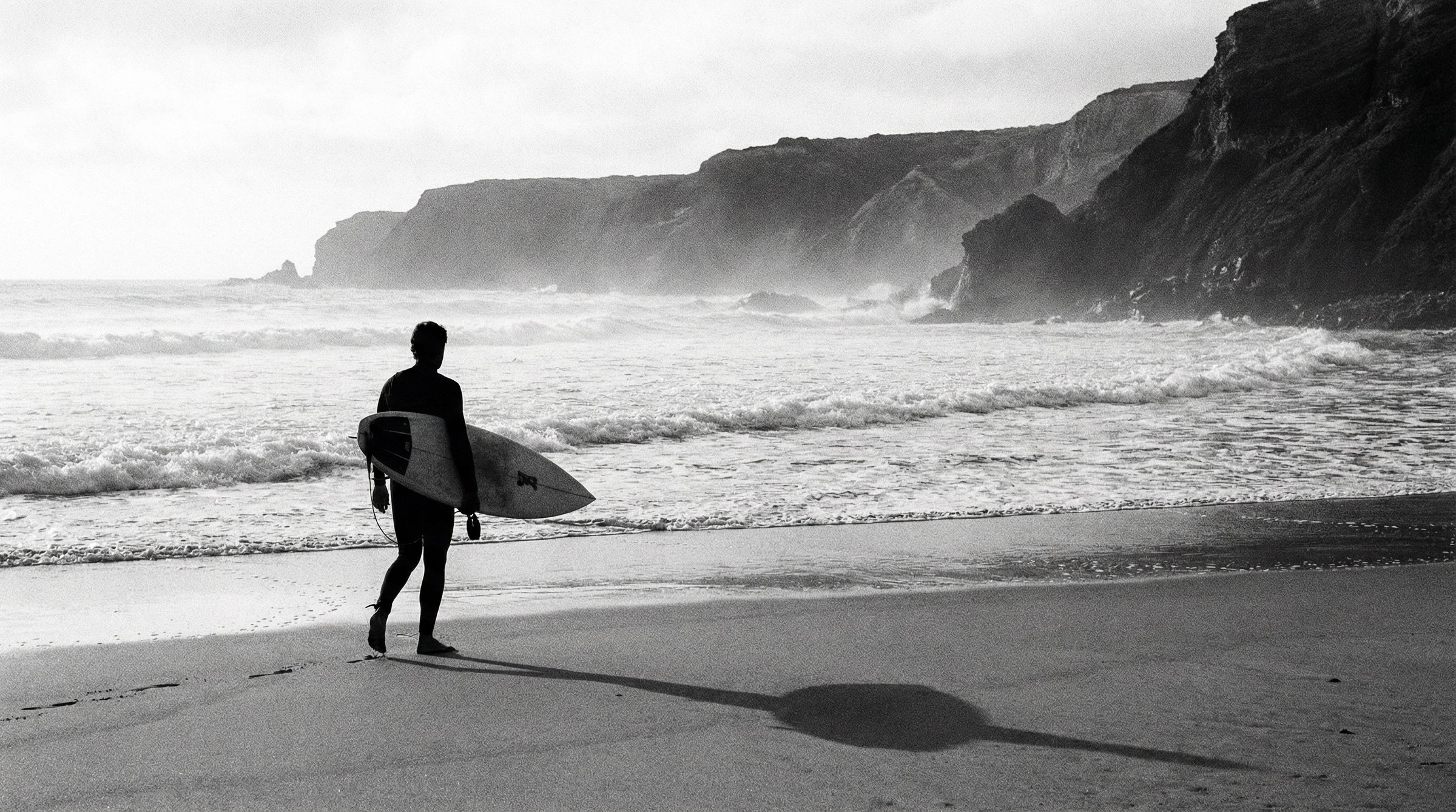
I paddled out this morning at 6:40. Air temperature 13 degrees. Water 15. Offshore wind, light, maybe 8 knots from the east. The swell was running northwest at 1.2 metres on a 12-second period — not big, not small, the kind of day that separates surfers who read conditions from surfers who check apps.
The app said “poor.” The ocean said otherwise.
This is what daily surfing teaches. Not how to ride a wave — you learn that in the first year. What daily surfing teaches is how to read everything that surrounds the wave. The wind direction and how it shapes the face. The tide stage and how it changes the break point by thirty metres over two hours. The current and where it pulls, which tells you where the channel is, which tells you where to paddle out without fighting the ocean. The crowd and their positioning, which tells you who knows the spot and who is guessing.
I have surfed nearly every day for decades. Not as a streak. Not as a challenge. As a practice — the way a musician practises scales, the way a photographer shoots daily, the way a coder ships daily. The repetition is not the point. What the repetition reveals is the point.
Here is what it reveals.
The ocean is not consistent. The same spot — Ribeira d’Ilhas, where I surf most mornings — is a different wave every single day. Same reef, same bottom contour, same geography. But the swell angle shifts by five degrees and the peak moves twenty metres south. The tide drops half a metre and a section that was makeable at mid-tide now closes out. The wind swings onshore by noon and the clean faces turn to mush. You cannot memorise this place. You can only keep showing up and paying attention.
This is the original feedback loop. In music, you play a note and hear whether it is right. In photography, you take the frame and see whether the composition holds. In code, you ship and watch whether users adopt. In surfing, you commit to a wave and the wave immediately tells you whether your read was correct. No lag. No committee. No analytics dashboard. The feedback is a clean ride or a face full of whitewater. The feedback is the ocean.
Repetition teaches pattern recognition that no single session can. After a thousand sessions at the same spot, you start to see the wave before it breaks. Not the swell line — any surfer sees that. The subtle shift in water texture forty metres outside that tells you a set is coming. The way the water draws off the reef two seconds before the lip pitches. The spot where the current creates a slight bump in the surface that marks the exact takeoff zone. These are not skills you learn from a video or a book. They are skills that accumulate through volume, the way a jazz musician’s ear develops through ten thousand hours of listening — not through theory, through exposure.
Your body is the instrument, and it changes daily. Some mornings my shoulders are loose and the paddle feels effortless. Some mornings my lower back is tight from a late session at the guitar the night before and every duck dive is a negotiation. The daily practice teaches you to work with whatever body showed up that morning, the same way a singer works with whatever voice they have on a given night. You don’t cancel the session because you’re at 80 percent. You surf at 80 percent and learn something different than what 100 percent teaches.
This is the part that weekend surfers never access. A two-hour session on Saturday gives you a snapshot. A two-hour session every day gives you a time-lapse. You see the patterns across days, across tides, across seasons. You notice that the wave is better in November than in August — not because the swell is bigger, but because the sand bar has shifted over the summer and the bottom contour is more defined. You notice that your surfing improves after three consecutive days of bigger waves because your paddle fitness ramps up and your commitment threshold drops. You notice that the days after a flat spell are harder not because you forgot how to surf but because your timing recalibrates every time you take a break.
The same principle applies in every domain I care about.
I play guitar daily. Not always for an hour. Sometimes for fifteen minutes — just scales, just chord changes, just the opening riff of “Whole Lotta Rosie” until the timing sits in the pocket and my picking hand is relaxed. The daily touch keeps the neural pathways warm. Two days off and the finger memory is still there but the feel is gone. Feel is the first thing to go and the last thing to come back.
I shoot daily. Not always something worth keeping. Sometimes a frame of light on the kitchen wall at 7 a.m. through the XF 35mm f/1.4, just to keep my eye active, to keep the composition instinct firing. The camera in the hand is the practice. Not the keeper.
The through-line is craft through repetition. Not repetition as routine — repetition as accumulation. Each session deposits a thin layer. A single layer is invisible. A thousand layers is a cliff face.
The ocean taught me this before anything else did. Show up. Pay attention. Respond to what is actually happening, not what you expected. The wave does not care about your plan. Your job is to be in the right place with enough fitness and enough attention to respond.
That is the practice. The rest is noise.
More from this domain
20 Aug 2026
OceanThe Wave That Never Reads You Back
A soliton is a wave engineered to never change. That is the point of Surf Ranch — and the exact reason it can teach a turn but never teach the ocean.
14 Jul 2026
OceanReading the Swell Before It Arrives
I check the 5am forecast half-asleep — and the math behind it was written in 1947 to put landing craft on a beach under fire.
26 Jun 2026
OceanThe Fin Setup Nobody Owns
Every board at Ribeira d'Ilhas ran three fins this morning. Mine too. Simon Anderson drew that setup in 1980 and never owned a cent of it.