
Why 50mm Is Amazing
The 50mm forces you to see with your feet. No zoom means you commit to the distance. The constraint is the teacher.
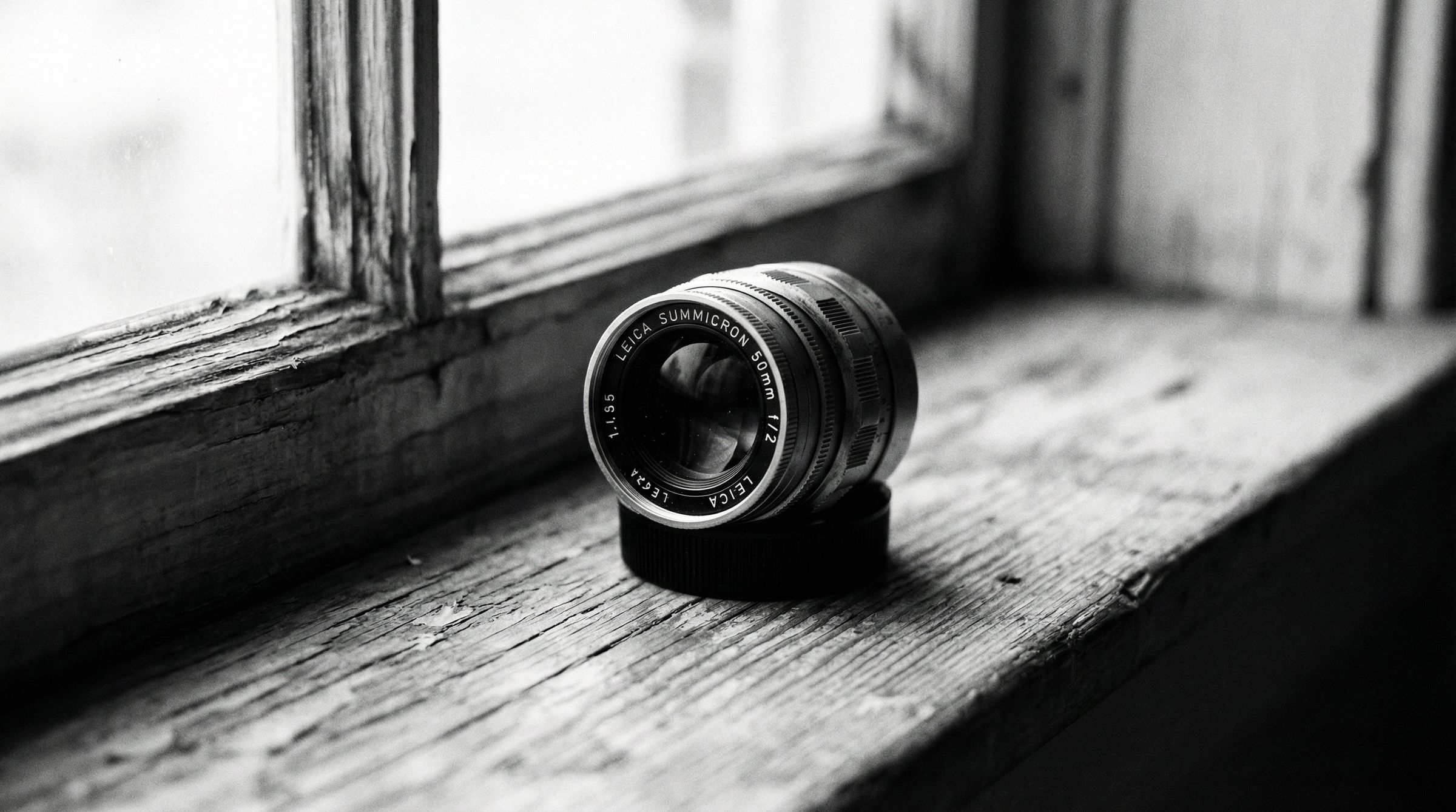
I own one lens. The Fujifilm XF 35mm f/1.4 R, which on an APS-C sensor gives a 50mm-equivalent field of view. Not wide enough to cheat with context. Not long enough to compress without consequence. You see what is in front of you, at the distance a conversation happens.
That is the entire discipline.
Zoom lenses teach you to stand still and twist a barrel. Prime lenses — and the 50mm in particular — teach you to move. Too much sky in the frame? Walk forward. Subject too tight? Step back. Distracting element on the left edge? Move two feet to the right. Your feet are the zoom. Your body position is the composition tool. After a year of shooting nothing but 50mm, you start pre-visualizing frames before the camera comes up to your eye. You learn to see in rectangles at that exact field of view, the way a musician learns to hear chord changes before they land.
The XF 35mm f/1.4 is not a perfect lens by modern standards. It hunts in low light. The autofocus motor is the old type — a screwdriver mechanism, not the linear motors Fujifilm puts in newer glass. It is not weather-sealed. The focus ring has slight play. On paper, the newer XF 35mm f/2 R WR is sharper, faster to focus, lighter, and sealed against the elements. I have tried it. I came back to the f/1.4 within a week.
The reason is rendering. Wide open at f/1.4, the older lens produces a quality of out-of-focus areas that the f/2 cannot match. The bokeh is not just blurred — it is textured, organic, with a gradual transition from sharp to soft that gives images a three-dimensional quality. Stopped down to f/4 or f/5.6, the lens is razor-sharp across the frame with a micro-contrast that makes black and white work sing. The Acros film simulation on the X-E5, pushed through this lens, produces images that feel like they were shot on Neopan 100 — deep blacks, luminous mid-tones, grain that sits in the image like it belongs there.
(The fact that I can describe the rendering character of a single lens in this much detail is the argument for owning one lens. You learn the instrument.)
There is a version of photography where you buy the right lens for every situation. The 16mm for landscapes. The 23mm for street. The 35mm for portraits. The 56mm for tight headshots. The 90mm for compression. You cover all the focal lengths and you always have the “right” tool. You also spend every shoot making a decision about which lens to mount instead of making a decision about what to photograph.
I have been down that road. I carried three lenses for two years. What I learned is that optionality is a tax. Every choice you make at the gear level is a choice you are not making at the compositional level. The energy budget for decisions is finite — psychologists call this decision fatigue, and it is real. The single-lens discipline eliminates an entire category of decisions and redirects that energy toward the image.
This is the same lesson surfing teaches. A single-fin board — a 6’2”, 21” wide, no side bites, one fin — forces you to surf differently than a thruster. You cannot pump through sections the same way. You cannot snap off the top the same way. What you can do is hold a line, read the wave face, and commit to a trim that the thruster surfer never finds because they are too busy generating speed through hardware. The constraint reveals a different conversation with the wave. One that most surfers never hear because they have three fins doing the talking for them.
It is the same lesson Angus Young’s rig teaches. One guitar, one cable, one amp. No pedals. The constraint is not a sacrifice. The constraint is the clarity.
Every domain I care about teaches this. One lens. One fin. One amp. The reduction strips away the noise and leaves you with the signal — your eye, your body, your hands. The tools stop being the variable. You become the variable.
The 50mm sees the world at conversation distance, with enough depth of field control to separate a subject from its context and enough width to show where the subject lives. It is the lens Henri Cartier-Bresson used. It is the lens Peter Lindbergh used. Not because they could not afford others. Because the 50mm is already enough, and enough is where the work begins.
More from this domain

25 Aug 2026
PhotographyThe Case for Printing
The screen is a proof. The print is the photograph. An image that only ever lived on glass is unfinished work — a mix you never bounced.
24 Jul 2026
PhotographyHow to Read Light
Reading light is a trained skill, not luck. You see the finished frame before you raise the camera — the same way you read a set before it stands up.
16 Jun 2026
PhotographyThe GFX Question
The GFX 100S is not a better X-E5. It is a different instrument, and I keep the X-E5 anyway.