
Angus: A Guitar, a Cable, and an Amp
Angus Young's signal chain is three components long. In a world drowning in options, his constraint is the conviction.
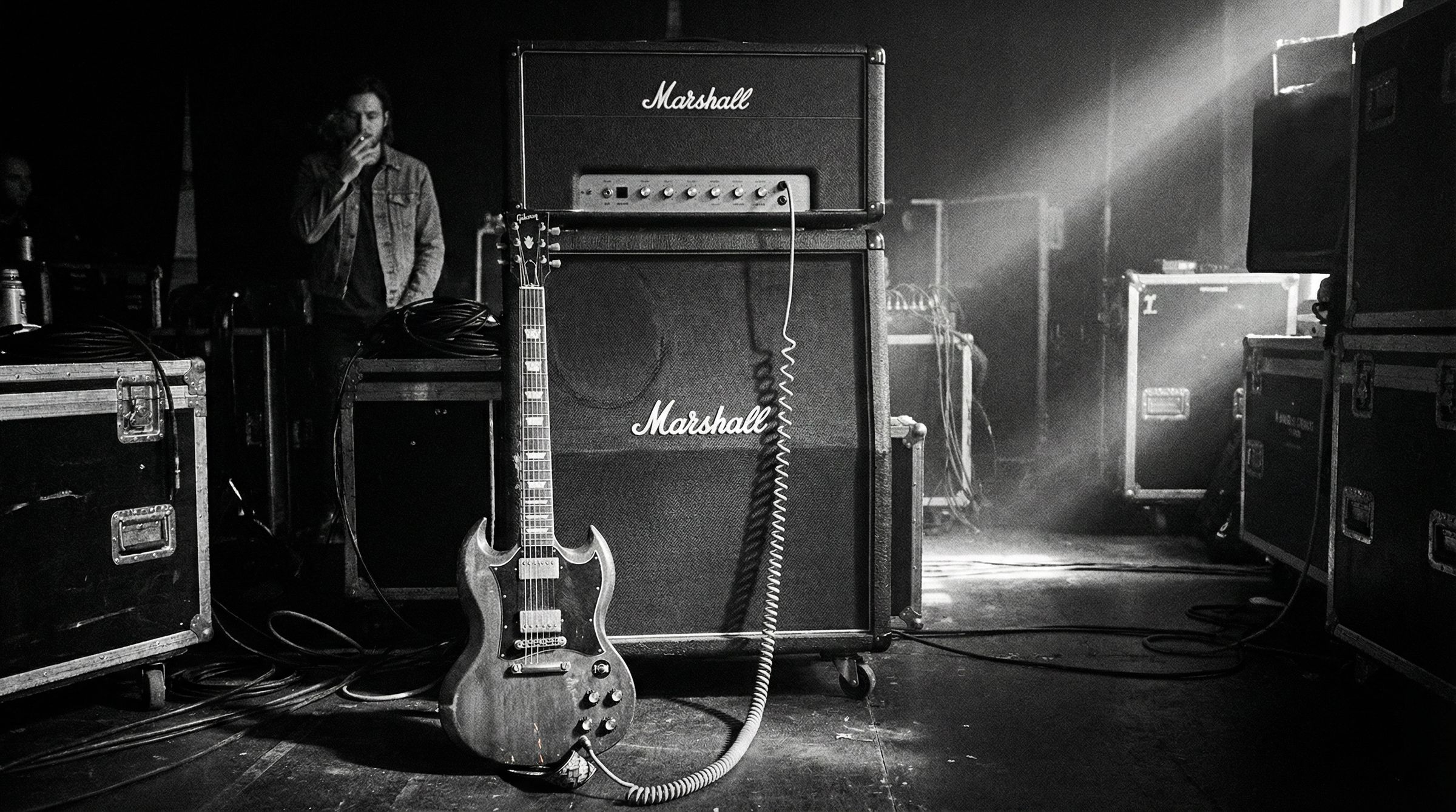
Angus Young has never used a pedalboard. Not once. Not in the studio, not on stage, not across fifty years and hundreds of millions of records sold. A Gibson SG Standard into a cable into a Marshall. That is the entire signal chain. Three components. No effects loop. No rack unit. No tuner pedal. He tunes by ear or not at all.
Most guitarists treat their rig like a kitchen — more tools, more options, more insurance against the possibility that the next song might need something they don’t have. Angus treats his like a blade. One edge. Keep it sharp.
The SG Standard is not a complicated guitar. Two humbuckers, a toggle switch, two volume knobs, two tone knobs. The neck is thin — a 60s SlimTaper profile that lets his hand fly but offers no forgiveness if his intonation drifts. The body is light, barely eight pounds, mahogany through and through. No maple cap to brighten the top end. No coil-splitting to fake a single-coil sound. The guitar is what it is. Angus decided that was enough sometime around 1973 and never revisited the question.
The amp side is just as stark. Early AC/DC records — the ones that defined the sound, High Voltage through Back in Black — were driven by Marshall JTM45s and Plexis. The JTM45 is Marshall’s first amplifier, designed in 1962, essentially a hot-rodded Fender Bassman circuit with British components. It breaks up early and unevenly, rewarding players who control dynamics with their picking hand rather than a gain knob. The Plexi — the 1959 Super Lead, 100 watts through a 4x12 loaded with Celestion G12Ms — is louder and tighter but still fundamentally a clean amplifier pushed into distortion by volume. Not by a pedal. By turning the thing up until the power tubes compress and the speakers start to work.
This is the part most people miss. Angus’s tone is not a preset. It is a physical event. The tubes in the Marshall are being driven into saturation by sheer volume. The speakers are moving enough air to change the behavior of the cabinet. The guitar’s pickups are reacting to the sound pressure coming off the amp — that is where the sustain and the feedback come from. Remove any component and the system collapses. Add a component and you dilute it.
I think about this every time I see a pedalboard with eighteen stomps and a switching system that requires its own power supply. The player has options. Angus has conviction. The difference is audible.
There is a parallel in every craft. The photographer who carries three zooms and two primes and a bag of filters versus the one who walks out with a single 50mm and shoots until the card is full. The surfer who owns nine boards for nine conditions versus the one who rides a 6’2” thruster in everything from two-foot mush to overhead walls and learns to adapt the approach instead of the equipment. The coder who evaluates twelve frameworks before writing a line versus the one who picks the tool, ships the product, and iterates.
The constraint is not a limitation. The constraint is the statement.
Malcolm Young understood this even more ruthlessly. Malcolm played rhythm — the engine room, the part that most people never notice and the band cannot survive without. His rig was simpler than Angus’s. A Gretsch Jet Firebird with the neck pickup removed — physically removed, the hole covered with a plastic plate — into a Marshall. One pickup. One cable. One amp. He removed the option of switching to the neck position because he knew he would never need it. That is commitment at the level of surgery.
Together, the Young brothers built a body of work that has sold over 200 million albums. Every one of those records sounds like AC/DC within two seconds. Not because of a production trick or a studio effect, but because the signal chain is the identity. You hear the SG’s mahogany growl hit the Marshall’s power section and there is no ambiguity. No other band in history sounds like that because no other band committed that completely to that narrow a set of tools.
The lesson is not “use less gear.” The lesson is: know what you need and refuse the rest. Every addition to your signal chain is a decision you are deferring. Every pedal is a hedge. Every option is an admission that you have not yet decided what you sound like.
Angus decided. The riff does the talking.
More from this domain
4 Sept 2026
MusicPAF: The Pickup That Should Not Exist
Gibson printed the wrong patent number on its own legendary pickup for years. The PAF fails every modern QC test — and that failure is the tone.
3 Aug 2026
MusicThe Accidental Circuit
The Neve 1073 is the most worshipped preamp in recording, and the sound everyone chases is a defect its own designer set out to engineer away.
1 Jul 2026
MusicThe Floor Under House Music
The TR-909 and TB-303 were flops. That is the reason house exists — I can trace the whole genre to a supply chain of failed gear.