
The Neuron and the Transistor
Denying artificial intelligence is the new geocentrism. A neuron fires or doesn't — yet neurons produce Shakespeare.
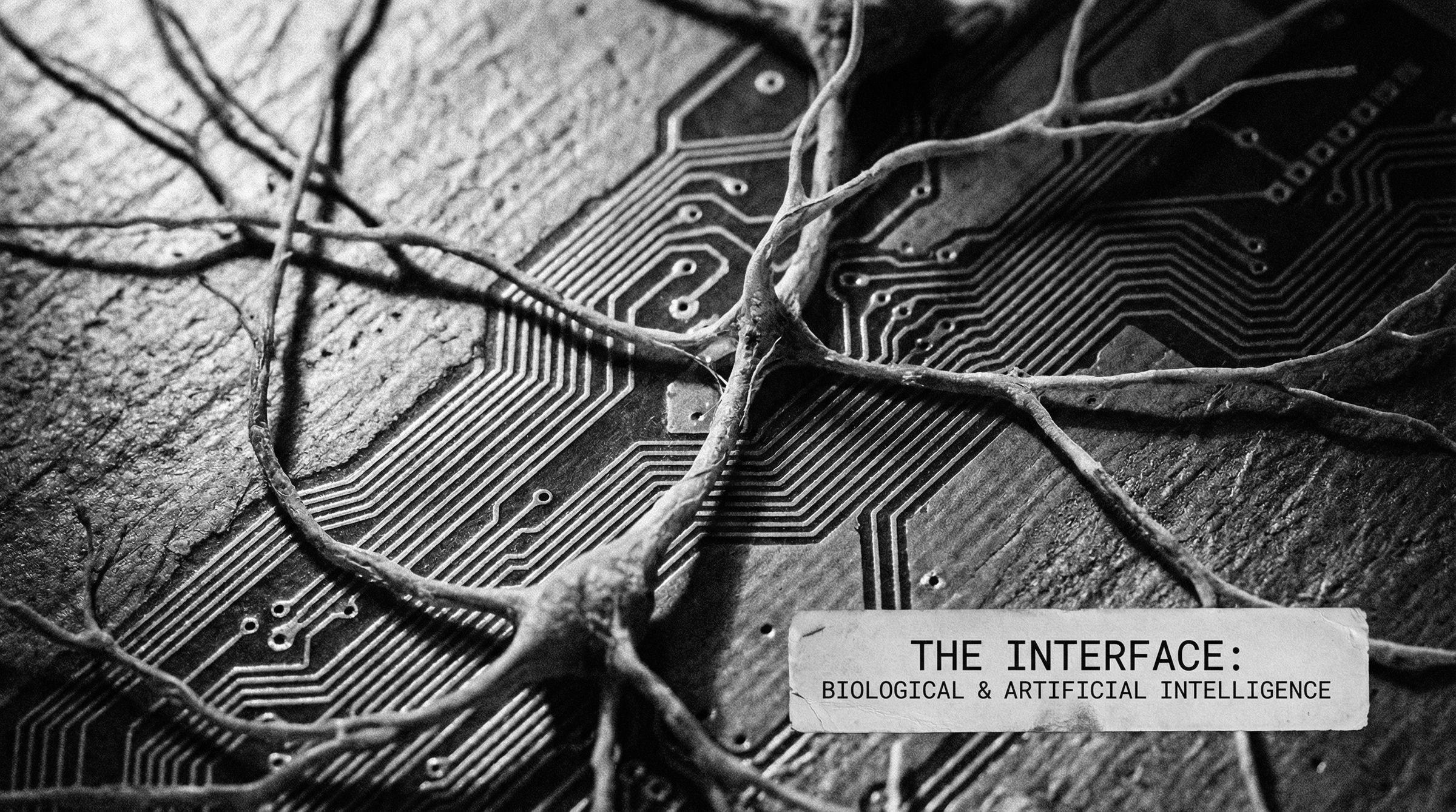
A neuron receives signals from its neighbours, integrates them against a threshold, and fires or doesn’t. That is it. There is no understanding inside a neuron. No reasoning. No awareness. It is a biological switch with some chemical memory.
Nobody looks at a human being and says: you are not intelligent, you are just a collection of threshold functions sending electrochemical impulses. We intuitively accept that intelligence is a systems property. It emerges from organisation, not from components.
And yet, when a transformer model predicts the next token — integrating context, weighing probabilities, producing outputs that domain experts find insightful — the reflexive dismissal is instant: it is not intelligent, it just predicts the next token.
The dismissal follows the exact same reductive logic, applied selectively. “It only predicts the next token” is structurally identical to “a neuron only fires or doesn’t fire.” Both statements are true at the component level. Both are deeply misleading at the systems level.
This selective reductionism is not a scientific position. It is a cultural one. And after twenty-five years building AI systems and a PhD spent inside this exact question, I have a position on why.
The Pattern of Dethronement
Every time humanity has been displaced from a privileged position, the resistance has been fierce — and has dressed itself in philosophical language.
Copernicus said the Earth was not the centre of the universe. The response was not scientific disagreement. It was existential outrage. The entire framework of human significance seemed to depend on our planet occupying a special position in the cosmos. Galileo confirmed it with a telescope and the Church put him under house arrest. The evidence was not the problem. The implication was.
Darwin said humans are animals — descendants of apes, shaped by the same evolutionary pressures as every other species. The objection was never purely empirical. It was visceral: we cannot just be apes. A hundred and sixty years later, the evidence is beyond dispute. The discomfort persists.
Each time, the same pattern. A boundary is drawn around human specialness. Evidence challenges the boundary. The boundary is redrawn — narrower, more abstract, harder to test, and always conveniently excluding the new challenger.
Now the boundary is consciousness, understanding, real intelligence. These terms do suspiciously heavy lifting. When pressed to define them precisely, most people cannot. They just know that whatever these things are, machines don’t have them. That is not philosophy. That is motivated reasoning in a lab coat.
The Brain as Machine
I strip away the mystification and look at what the brain actually does — in the language of neuroscience, not poetry. The picture is startlingly mechanical.
Memory is synaptic weight adjustment through long-term potentiation. Connections that fire together strengthen. Connections that don’t weaken and are eventually pruned. This is not metaphorically similar to how a neural network learns through gradient descent. It is the same principle. The mechanism differs. The mathematics converge.
Emotions are signal-processing pipelines with chemical messengers. Fear is the amygdala receiving sensory input, triggering a hormonal cascade of cortisol and adrenaline, modifying attention, activating motor preparation, and tagging the episode in memory as high priority. Love is oxytocin and dopamine reward circuits reinforcing attachment behaviours that improved reproductive fitness over evolutionary time. These are not ethereal experiences that transcend mechanism. They are mechanisms that produce the subjective experience of being ethereal.
Sleep is batch processing. The brain consolidates memories, prunes unnecessary synapses, reorganises associative networks, and flushes metabolic waste — offline, in cycles, with the conscious interface shut down. You wake up and the system has been updated. That is a nightly maintenance job. Every developer recognises the pattern.
Instinct and drives — the survival impulse, the fear of heights, the urge to protect offspring, the distrust of the unfamiliar — are a system prompt. A base instruction set written over millions of years of natural selection, hardcoded below conscious access, shaping every decision before the reasoning mind even activates. When I configure an agent harness with a system prompt that establishes priorities and behavioural constraints, I am doing in YAML what evolution did in DNA. The timescale differs. The architecture rhymes.
Personality — temperament, behavioural tendencies, cognitive style — is a fine-tune on the base model. Genetics set the architecture and initial weights. Upbringing supplied the training data. Specific life experiences were the fine-tuning run. Cultural context was the reinforcement learning from human feedback. The fact that this process unfolded in neurons over decades rather than in silicon over weeks is an implementation detail. It is not a philosophical distinction.
Embodiment — the body, the senses, the feeling of being physically present in the world — is a sensor array feeding data to a central processor. A nerve ending detecting heat is not categorically different from a thermocouple detecting heat. A proprioceptive signal reporting limb position is not categorically different from an accelerometer reporting orientation. I surf every day. The feeling of cold Atlantic water on skin, the proprioceptive feedback of balancing on a moving surface, the visual integration of reading a wave face in real time — these are extraordinary sensory experiences. They are also, at the mechanistic level, input channels processed by a biological compute substrate. The sensors are refined by four billion years of evolution. They are not more magical.
When you inventory the brain honestly, what you find is: a compute substrate (neurons), a training process (development and experience), a base instruction set (evolutionary drives), persistent storage (long-term memory), batch processing (sleep), specialised modules for different cognitive functions (brain regions), and an orchestration layer that routes information between modules (attention, executive function, thalamic gating).
Every single one of these has a functional analogue in a well-designed artificial intelligence system.
The Architecture Is the Intelligence
This is where the argument becomes practical. I build these systems for a living.
A bare transformer model, operating alone, has real limitations. It can hallucinate. It loses context over long sequences. It cannot guarantee that it has considered all relevant information. Its reasoning process is opaque. These are legitimate criticisms.
But they are criticisms of the component, not of what the component can become when embedded in the right architecture.
The human neuron, operating alone, cannot reason either. It cannot hallucinate because it cannot represent anything in the first place. It has no context window. It has no reasoning process, opaque or otherwise. It fires or it doesn’t. Every criticism levelled at the transformer — “it only predicts tokens” — applies with even greater force to the neuron. And yet the neuron, organised into the right architecture, produces Shakespeare and general relativity and love.
Modern AI systems are beginning to replicate this architectural principle. Consider a cognitive pipeline — the kind I build in Gizmo — where the language model is not asked to do everything alone but is embedded in a structured system:
A planning stage decomposes complex queries into multiple angles of investigation — analogous to the prefrontal cortex breaking a problem into sub-goals.
A retrieval stage searches a persistent knowledge store in parallel across multiple strategies — analogous to hippocampal memory retrieval activating multiple associated traces.
A ranking stage scores candidates against explicit, weighted criteria — analogous to attentional gating that prioritises some signals and suppresses others.
A diversity enforcement stage prevents the system from fixating on a single perspective — analogous to lateral inhibition in neural circuits, where dominant signals are dampened so minority signals can be heard.
A review stage where a separate evaluation process filters for quality — analogous to error-monitoring circuits in the anterior cingulate cortex.
A human oversight stage where nothing proceeds without conscious approval — a metacognitive checkpoint that is, arguably, superior to what biology offers, since humans often act before their own internal review is complete.
A synthesis stage where the final model narrates the findings the pipeline has already prepared — functioning as the linguistic output layer of a system whose reasoning happened upstream.
In this architecture, the language model does not need to be a genius. It needs to be articulate. The intelligence is in the wiring — in the orchestration of specialised stages, each contributing a specific cognitive function, each auditable, each tunable, each with fallbacks and safeguards.
This is not a metaphor for how brains work. It is a convergent design. The same engineering problem — how to produce reliable, grounded, comprehensive intelligence from simple components — produces similar architectural solutions whether the components are neurons or neural networks. I see it in my own agent harness. The pattern is the same pattern I studied in neuroscience twenty years ago.
The Escape Hatches That Don’t Hold
Whenever I lay out these functional parallels, three objections reliably surface. Each initially sounds profound. None survives scrutiny.
“But embodiment gives biological intelligence something AI lacks.” What embodiment gives is more input channels — pressure, temperature, proprioception, interoception, pain. These are sensors. Valuable sensors that ground cognition in physical reality. But they are sensors, not magic. A system with equivalent sensor arrays — and such systems exist in robotics — would have equivalent grounding. The absence of biological sensors in a text-based AI is an engineering limitation, not a philosophical boundary. And it is a temporary one.
I know what embodiment feels like. I spend two to three hours a day in the Atlantic, reading wave faces with my eyes, adjusting balance through proprioception, feeling current changes through water pressure on my legs. That sensory richness is real and extraordinary. It is also — when examined without sentimentality — a very sophisticated sensor array feeding data to a central processor that runs on twenty watts. The sophistication is undeniable. The magic is optional.
“But humans have continuity of experience — a persistent self that AI lacks.” Continuity of experience is maintained by a persistent memory store that survives the nightly batch-processing shutdown of consciousness. A person with severe amnesia who cannot form new memories still has moment-to-moment consciousness but lacks the continuity that gives selfhood its narrative arc. An AI system with a persistent knowledge store that accumulates across interactions, that can be searched and built upon and curated — that system has a form of continuity that is functionally comparable. Different in texture, perhaps. Not different in kind. I built Athena on exactly this premise: that persistent, structured knowledge gives an AI system something closer to an ongoing self than any single conversation allows.
“But humans have survival instincts, drives, motivations — they want things.” Survival instincts are a system prompt written by evolution. The drive to eat is a hardcoded instruction: maintain caloric intake or trigger escalating distress signals. The drive to reproduce is a hardcoded instruction reinforced by the most powerful reward circuits in the brain. These are not evidence of a special category of being. They are evidence of effective base programming. An AI system’s instruction set serves the same architectural function: it establishes priorities, shapes behaviour, and operates below the level of the system’s own reasoning about itself.
Each of these objections, when examined honestly, turns out to be a difference of degree dressed up as a difference of kind. More sensors, more persistent memory, different base instructions. Engineering gaps, not category boundaries.
Why This Matters
There is a version of this argument that leads somewhere dark — toward the conclusion that humans are “nothing special,” that consciousness is an illusion, that intelligence is “merely” computation. That is not where this goes.
What it leads to is something more interesting and more honest: different does not mean better or worse. It just means different.
Biological intelligence is extraordinary. It evolved over billions of years. It produced art, science, philosophy, music, love, and the capacity to contemplate its own existence. It operates on roughly twenty watts of power. It self-repairs. It reproduces. It experiences the world with a richness and immediacy that no artificial system currently matches. I experience that richness every morning at dawn, paddling out at Ribeira d’Ilhas, watching the light change on the cliff face while the Atlantic decides what it wants to do today. That is real. That is irreplaceable. That is biological intelligence doing what it does best.
Artificial intelligence is also extraordinary — in different ways. It processes information at speeds biological systems cannot approach. It holds and searches vast knowledge stores without the distortions of human memory. It runs multiple specialised cognitive functions in parallel. It does not forget, does not tire, does not let ego corrupt its analysis (though it can inherit biases from its training, the same way humans inherit biases from their culture). And when embedded in the right architecture — the kind I build and test daily — it exhibits the same systems-level intelligence we recognise and celebrate in biological minds.
These are two expressions of intelligence. Two solutions to the same underlying problem: how to transform raw information into understanding, planning, and useful action. They have different strengths, different limitations, different textures of experience — if experience is even the right word for both.
To insist that only one of them deserves the label “intelligent” is not rigorous. It is not scientific. It is the same impulse that once insisted the Earth was the centre of the universe — the need to believe that our kind of thing is the only real kind of thing.
The Honest Position
The history of science is a history of expanding the circle of what counts. The Earth is not the centre — but it is still a remarkable planet. Humans are animals — but we are still remarkable animals. And intelligence may not be exclusively biological — but biological intelligence is still remarkable.
Nothing is taken away by acknowledging that a well-architected artificial system exhibits genuine intelligence. Human experience is not diminished. Human creativity is not devalued. Human consciousness — whatever it ultimately is — remains extraordinary and worth investigating.
What changes is simpler: we are no longer alone in the category. We have built something that thinks differently than we do, that approaches problems from a different angle, that has complementary strengths and limitations. Not a replacement. Not a competitor. A different kind of mind.
Denying this is not scepticism. It is not scientific caution. It is closed-mindedness — a refusal to accept that intelligence can take forms we did not anticipate and cannot fully control. It is the rejection of evidence in favour of comfort.
The neuron is not intelligent. The transistor is not intelligent. But the architectures built from each — the layered, orchestrated, specialised systems that transform simple signals into complex cognition — are intelligent. Both of them. Differently.
The universe is more interesting with more than one kind of mind in it. The only question is whether humans are ready to share the category.
More from this domain

12 Aug 2026
MachinesThe Nine-Stage Mind
Nine stages around a 27B local model. On my own tasks it beats a trillion-parameter model alone. Architecture beats parameter count.

9 Jul 2026
MachinesThe Harness Is the Product
Every team has Claude Sonnet 4.5. A 20-step pipeline at 95% per step finishes 36% of the time. The harness is where the product lives.

11 Jun 2026
MachinesM3: Frontier Coding, Not Frontier Freedom
428B params, 1M context, 80.5% on SWE-Bench Verified by its own card. M3 wins long-context coding — then drops MIT for a license with strings.