Athena: The Problem Nobody Talks About
The AI notes industry sold a lie. They said the problem was access to AI. The real problem is the workflow — copy-paste, lose context, repeat.
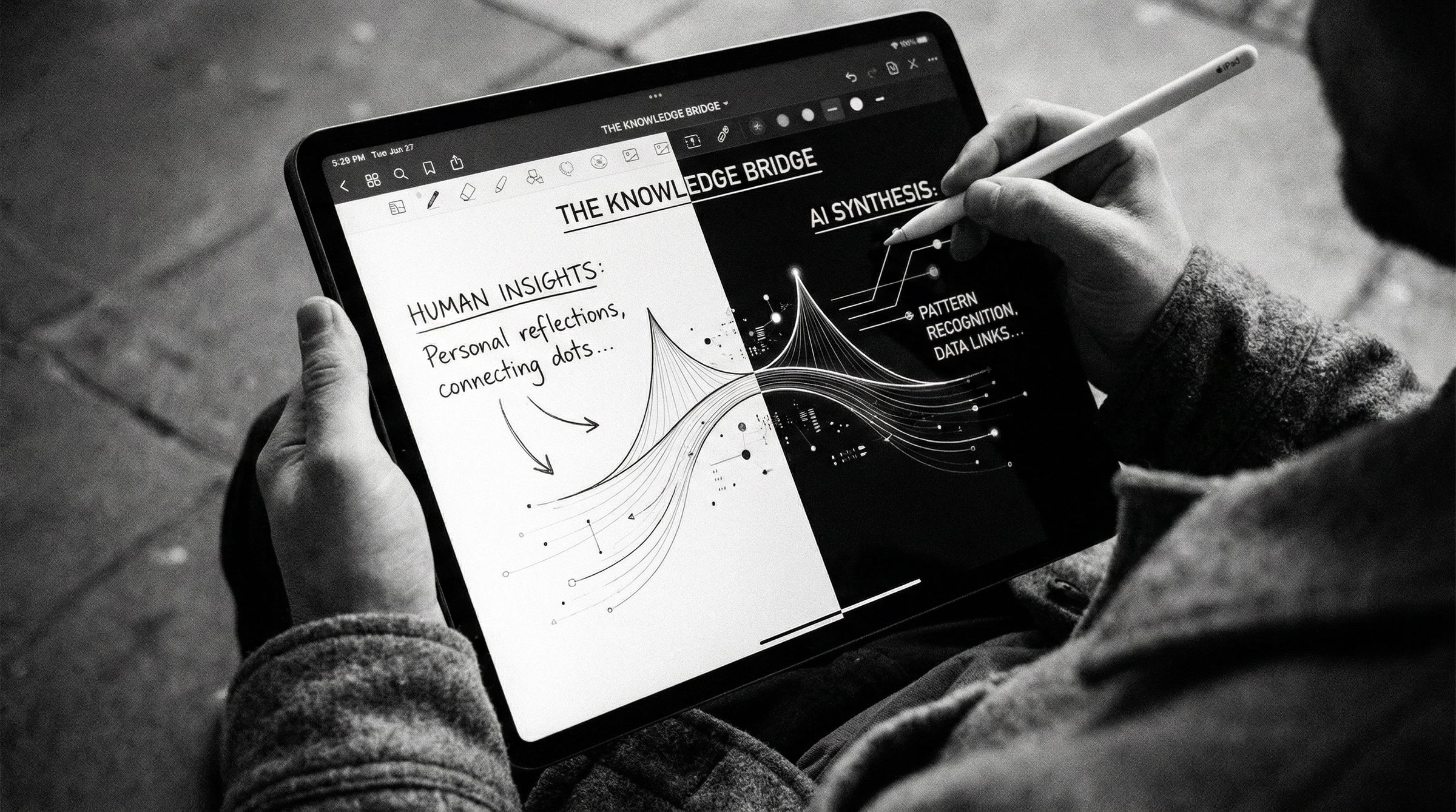
I keep twenty-three tabs of context open when I work with Claude on a research synthesis. Twenty-three. I know because I counted last Tuesday, mid-session, when I realised I had been copying and pasting for forty minutes and had not yet asked Claude a single question about the actual research.
Here is what that workflow looks like, in case you have been doing it so long you have stopped noticing how broken it is. Open a note. Select the relevant section. Copy. Switch to Claude. Paste. Go back. Open the next note. Realise it references a third note. Open that. Copy a different section. Switch to Claude. Paste. Lose the formatting. Notice that the pasted text lost its headings and bullet structure. Reformat manually. Realise you forgot the constraint from last month’s meeting note. Go find it. Copy. Paste. Claude now has 4,000 tokens of context assembled from six different documents, none of which arrived with metadata, none of which preserves the relationships between them, and all of which lost their structure in the clipboard.
Ask the question. Get a good answer — Claude is smart enough to work with bad input. Copy the answer. Switch to your notes app. Create a new note. Paste. Tag it. File it. Link it to the original documents manually. Repeat tomorrow.
You are not collaborating with AI. You are a copy-paste janitor.
The Lie
The AI notes app industry — Notion AI, Mem, Reflect, the entire category — saw this problem and misdiagnosed it completely. They said: the problem is access to AI. The user needs AI inside the notes app. So they bolted a chat interface onto a filing cabinet, charged $20/month, and called it innovation.
Access was never the problem. I have access to Claude, ChatGPT, Gemini, and three local models running on my M4 Max right now. Access is free or nearly free. Access is abundant. The problem is what happens between your knowledge and the AI — the workflow, the transfer, the round trip.
Every “AI-powered” notes app does the same thing: your knowledge sits in folders, AI sits in a chat window, and you are the bridge between them. You copy from here. You paste to there. You organise the result. The AI is a feature bolted onto an architecture that was designed in 2010 for humans filing documents, not for humans collaborating with intelligence.
The architecture is wrong. Not the feature. The architecture.
The Workflow Problem
Break it down to the mechanical level. There are exactly four friction points in the human-AI knowledge workflow, and every existing app ignores at least three of them.
Friction 1: Context Assembly. Before you can ask AI anything useful, you need to gather the relevant context from your knowledge base. This is manual. You remember which notes matter (or you don’t, and you miss critical context). You open them one by one. You decide which sections are relevant. You copy. The AI never sees the notes you forgot to include. And you always forget to include something — because human memory is not a search engine.
Friction 2: Context Transfer. The clipboard is a lossy channel. Markdown becomes plain text. Structure disappears. Metadata — tags, links, dates, relationships between notes — is stripped entirely. The AI receives a wall of unstructured text and has to infer the structure that your notes app already had.
Friction 3: Output Capture. The AI produces something valuable — a research synthesis, a project plan, a structured analysis. It lives in a chat window. To use it, you copy it out. You create a new note. You paste. You manually add tags, links, folder placement. Every piece of organisational metadata that your knowledge base needs, you provide by hand.
Friction 4: Context Accumulation. Tomorrow, when you continue the work, the AI starts from zero. The synthesis it produced yesterday is in your notes app, but the AI does not know that. You copy-paste the previous output back into the new session, along with whatever new context has arrived. The round trip repeats. Nothing compounds.
Four friction points. Four places where knowledge degrades, context is lost, and the human does mechanical work that a well-designed system should eliminate entirely.
This is not a feature gap. This is an architecture problem. And you cannot fix an architecture problem by bolting a chat window onto a filing cabinet.
Athena’s Answer
I built Athena to eliminate the round trip.
The core insight is simple, once you see it: the notes app and the AI should not be the same system — but the bridge between them should be built into the architecture, not performed by the user.
Athena is a personal knowledge management app. Native macOS and iOS. Your notes live on your device, semantically indexed using Apple Intelligence and Spotlight. Markdown. Tags. Links. Folders. The notes app part is a notes app — well-designed, fast, private, but not trying to be an AI.
The AI collaboration part is Athena Flow. It is the two-way bridge that eliminates all four friction points.
Going Out: The .athenabrief
When you need AI to work with your knowledge, you start with intent. Tell Athena what you want to accomplish: “Synthesise my research on agent architecture.” “Prepare my quarterly review.” “Write the proposal for the Martinez project.”
Athena reads your intent, searches your knowledge base — not keyword matching, but semantic understanding using Apple’s NLP stack and Spotlight integration — and surfaces every note it considers relevant. It scores them for relevance. It identifies themes. It drafts a research report synthesising what it found. Then it shows you everything.
You review. You approve what leaves your device, remove what should not, add anything Athena missed. Nothing goes out without your explicit sign-off.
Athena packages the approved selection into an .athenabrief — a structured archive containing your intent, the research report, note summaries with relevance scores, full note contents, and all attached assets. The format uses progressive disclosure: the AI reads the brief and report first (often sufficient), summaries next (for triage), full notes only when depth is needed. This saves tokens, saves money, and produces better output because the model gets structured context instead of a text dump.
Drop the .athenabrief into Claude. Or ChatGPT. Or Gemini. Or a local model. Athena does not care which AI you use. Open standards. No lock-in.
Coming Back: The .athenapackage
The AI does its work with full context. Better context produces better output — this is not a claim, it is a measurable fact. The number one reason AI produces mediocre results is incomplete context: you forgot a constraint, you missed a reference, you did not include that decision from three weeks ago. Athena does not forget. It searches.
When the AI finishes, it bundles the results into an .athenapackage — using the Athena Skill (an Agent Skills standard instruction set that any model can follow). The package contains structured markdown notes with titles, tags, folder destinations, and inter-note links. Everything the knowledge base needs to file the output correctly.
Drop the .athenapackage into Athena. One click. The notes land in the right folders, with the right tags, linked to the right source documents. No manual filing. No copy-paste. No reformatting.
The round trip is complete. Knowledge flows out, structured and curated. Results flow back, structured and filed. The human stays in control of what leaves the device and what enters the knowledge base. The AI works with full context instead of clipboard fragments. The knowledge base grows with every interaction.
Why This Matters
Three things make this architecture different from everything else on the market.
Privacy is structural, not promissory. Every “AI-powered” notes app sends your data to a cloud API and asks you to trust their privacy policy. Athena’s knowledge base lives on your device. When you use Athena Flow, you see exactly which notes are included in the brief, you review the contents before they leave, and you approve the export. Not “we promise not to train on your data.” You literally inspect the package. Every time.
The AI is replaceable. The knowledge is not. Athena works with any model that accepts file uploads. Claude today, ChatGPT tomorrow, a local model running on your own hardware for sensitive documents. Your knowledge system does not depend on any single AI provider. The .athenabrief and .athenapackage formats are open, readable, standard archives. No proprietary lock-in. If Athena disappeared tomorrow, your notes are markdown files on your device. If Claude disappeared tomorrow, you drop the brief into a different model.
The workflow compounds. Every .athenapackage that returns to Athena becomes part of the knowledge base. Next time you work on the same project, that synthesis is already there — indexed, searchable, included in the next brief automatically if relevant. The AI’s output becomes the foundation for the AI’s next input. The knowledge base gets richer with every round trip. Nothing starts from zero.
The Signal Chain
I keep coming back to signal chains. In a guitar rig, the signal chain is everything — guitar, cable, pedals, amp, speaker. Every component in the chain either preserves the signal or degrades it. A bad cable introduces noise. A bad pedal sucks tone. A bad amp colours what should be clean. The signal chain disciplines you: every element must earn its place, and anything that degrades the signal gets removed.
The knowledge-to-AI workflow is a signal chain. Your notes are the source signal. The context assembly is the cable. The AI is the amp. The output capture is the speaker. Every current “AI-powered” notes app has a lossy cable (copy-paste), a noisy pedal (manual context selection), and a speaker that drops half the frequencies (manual output filing).
Athena is a clean signal chain. Knowledge out, structured and curated. Intelligence back, structured and filed. No lossy steps. No manual bridging. No degradation.
Free. Native. Private. Works with any AI.
The product the workflow actually needed. Not the feature the marketing deck said you wanted.
More from this domain

12 Aug 2026
MachinesThe Nine-Stage Mind
Nine stages around a 27B local model. On my own tasks it beats a trillion-parameter model alone. Architecture beats parameter count.

9 Jul 2026
MachinesThe Harness Is the Product
Every team has Claude Sonnet 4.5. A 20-step pipeline at 95% per step finishes 36% of the time. The harness is where the product lives.

11 Jun 2026
MachinesM3: Frontier Coding, Not Frontier Freedom
428B params, 1M context, 80.5% on SWE-Bench Verified by its own card. M3 wins long-context coding — then drops MIT for a license with strings.